

Where do human hair wigs come from? It’s a common question among beauty professionals and store owners. Understanding the source of human hair wigs helps you evaluate quality, ethics, and product suitability.
Why the Origin of Human Hair Matters?

Hair origin is not mere trivia — it’s the basis of wig performance. Various areas yield various hair textures, which influence the longevity, colorability, and look of the wig. To professionals, obtaining good-quality human hair directly correlates with client satisfaction and reputation.
European hair, for example, blends well with Caucasian hair types and is thus most in demand. Indian hair gives density and natural wave patterns, and Southeast Asian hair gives better strength. Knowledge of these differences allows the salons and the resellers to provide better client matches.
Moreover, original knowledge allows businesses to better inform customers about value. Customers are increasingly aware of the origin of their beauty products and wish to be open. Those experts who are able to discourse intelligibly on hair origins establish their reputation.
Where do human hair wigs come from?
India – The Largest Contributor

India is also the world’s most dominant supplier of human hair. Most of it derives from temple donations, where believers leave hair as a sign of religiosity. This hair, which might not be treated in any way, is perfectly suited for wigs because it is naturally thick and aligned.
Temple hair is typically Remy, with cuticles going in one direction, reducing tangling and matting. Indian hair is adaptable, blending easily with a range of textures and accepting different wig styles and processing needs.
It’s also readily available in black or dark brown shades, thus versatile to whichever dyeing process. With its common usage and quality potential, Indian hair is still a mid-to-high-end wig product bestseller.
China – Processing & Collection Hub

China is a behemoth in the wig supply chain, primarily in processing and manufacturing. Human hair from rural areas is sorted, cleaned, and processed to be made wig-ready. Chinese hair, although non-Remy to begin with, is chemically treated to mimic the look of superior grades of hair.
Though less expensive, Chinese hair may not be as durable as Indian or European hair. However, with good processing, it can be a decent choice for low-cost human hair wigs in bulk.
China’s infrastructure allows it to process hair in huge volumes, and as such, China is the global leader in wig manufacturing. Though quality may be unpredictable, the efficiency with which it processes raw hair to finished product cannot go unnoticed.
Eastern Europe – Premium Virgin Hair

Hair from countries like Russia, Poland, and Ukraine is highly sought after. It’s also referred to as Slavic hair, and it’s fine, silky, and typically lighter in color. These features make it ideal for light-colored wigs intended for Caucasian clients.
Eastern European hair is usually virgin and unprocessed, offering premium quality. Because of its rarity and texture, it’s often used in high-end wig designs where authenticity and luxury matter most.
Slavic hair is less available owing to reduced population and donation rates, and is costlier as a consequence. But for clients for whom natural color and softness are the overriding concerns, it remains the gold standard.
Southeast Asia – Thick, Strong Hair Types

Southeast Asian nations like Vietnam and Cambodia have dense, thick hair ideal for full wigs and toppers. Though less fine than Slavic hair, its hardness and thickness are positives for clients wanting volume and stability.
Southeast Asian hair has excellent durability and holds style well, with satisfactory dye retention. When processed properly, this hair is a top choice for wigs needing enhanced strength.
This kind of hair is typically double-drawn, which assures even length and volume across the wig. The majority of top brands now seek Southeast Asian suppliers for quality that competes with that of Indians.
How the Hair is Collected and Sorted
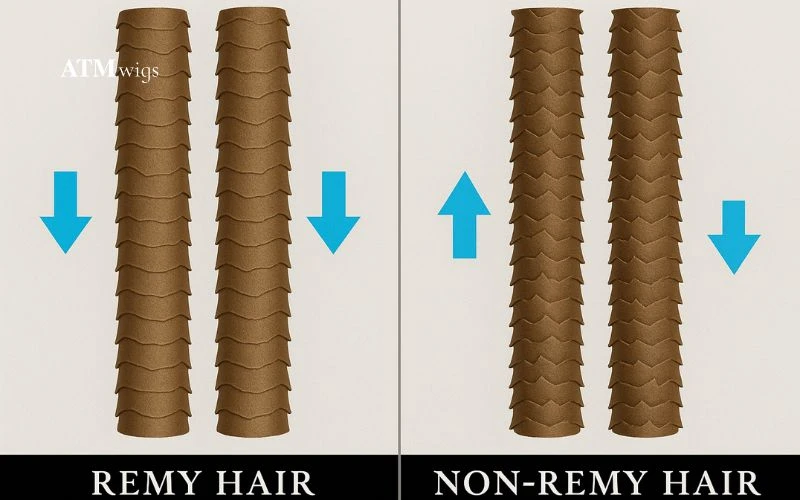
The collection method will have a significant influence on the quality of a wig. Volunteer donations, i.e., temple donations, create the highest-quality hair due to its natural condition and cuticle alignment. Commercial donor hair is not as uniform.
Sorting preserves Remy hair in its original form, i.e., all cuticles facing the same direction. Sorting is a labor-intensive process that discourages tangling and increases the life of the wig. Machine-sorted non-Remy hair is treated with silicone for slickness but has a reduced life.
In advanced sorting, human inspection is used to separate virgin, dyed, and processed hair. Manual grading also helps identify lengths, colors, and cuticle integrity, all of which determine wig pricing.
Ethical & Sustainable Hair Sourcing
Hair sourcing ethics are increasingly becoming important to conscientious brands and buyers. Ethically sourced hair would mean that donors are informed and adequately compensated. Good suppliers maintain traceability and promote open-sourcing practices.
ATM Wigs is concerned with working with partners who fulfill these parameters. With growing consumer awareness, brands that can prove ethical sourcing have a tendency to evoke greater trust, especially for higher-end retail or salon setups.
Unauthorized hair collection, especially in deprived regions, is a global issue. Being an expert, choosing suppliers who execute ethical practices not only protects your image but also ensures long-term trust from customers.
From Raw Hair to Finished Wig

Human hair, after collection, goes through an intense makeover. It is washed and sanitized, and it may be dyed, bleached, or left natural. High-end wigs are occasionally hand-tied for added realism.
The knotting process, hair density, cap building, and ventilation techniques all influence the end product’s look and texture. Stringent quality control ensures uniform results and professional-grade wigs ready for sale.
In top-of-the-line production, mono-tops and lace fronts are used to replicate scalp and add realism. Strands can be knotted into the foundation, requiring master skill — an endeavor that could take days to finish for one wig alone.
What Retailers & Professionals Should Know
For salon owners and retailers of wigs, knowing the origin of the hair makes it easier to match the product with the customer. European hair may suit blond customers, while Indian or Southeast Asian hair gives body and styling versatility.
Collaboration with established manufacturers that are transparent about their sourcing and quality practices is paramount. Not all manufacturers are willing to cooperate, so cooperation with industry professionals, such as ATM Wigs, eliminates risk and maintains brand reputation.
Buyers must also ask for samples, demand supplier certification, and ask how returns are handled to ensure they are receiving exactly what they were promised, especially with wholesale or private-label buying.
FAQs About the Origins of Human Hair Wigs
Is human hair in wigs really from people?
Yes, it is. Human hair for wigs is harvested from real donors through religious sacrifice, salon donations, or commercial voluntary donations.
Why is European hair more expensive?
European or Slavic hair is naturally finer, lighter, and scarcer. Such rarity, along with quality stature, drives its market price up.
Are all human hair wigs ethically sourced?
Sadly, no. Ethical sourcing includes donor consent, fair pay, and open supply chains. Always query your supplier.
How can I tell where the hair in a wig came from?
Good manufacturers provide origin details, quality stamps, and perhaps sample testing. Openness is a sign of a good partner.
Does the hair origin affect how a wig performs?
Yes. Texture, thickness, and processing past vary by source, impacting appearance, styling, and durability.
What is Remy hair, and why does it matter?
Remy hair maintains the cuticles aligned, which reduces tangling and maximizes life expectancy. It’s a key indicator of high-quality wigs.
Conclusion: Know the Origin, Offer Better Wigs
Being aware of “Where do human hair wigs come from?” allows you to choose with assurance. For professionally sourced, ethically supplied grade-A wigs, trust ATM Wigs — your quality hair partner.

