

In terms of choosing human hair vs synthetic toupees, it’s about how well the hair blends, how much styling freedom you want, and how much upkeep you’re willing to fit into your routine. This guide compares the two materials, so you can make your choice with confidence.
Human hair vs synthetic toupees at a glance
Both substances can create a realistic hair replacement effect but they react differently in day to day wear. Natural hair is usually more flexible for styling and more natural in its movement, but synthetic hair is often easier to maintain in a consistent, pre-set style.
| Feature | Human hair toupees | Synthetic toupees |
|---|---|---|
| Appearance | Natural variation in shine and movement | Realistic when fiber quality and finish are well matched |
| Blending | Easier to reshape alongside growing hair | Requires an accurate texture and shine match |
| Heat styling | Usually possible with proper precautions | Restricted to approved heat-friendly fibers |
| Style retention | Often needs restyling after washing | Typically returns to its preset style |
| Maintenance | Conditioning and regular styling | Less restyling, but fiber-specific care |
| Durability | Depends on processing, handling, and base quality | Depends on friction, heat exposure, and base quality |
| Price | Generally higher initial cost | Often lower initial cost |
Neither material guarantees a natural result; a close match to your remaining hair matters most.
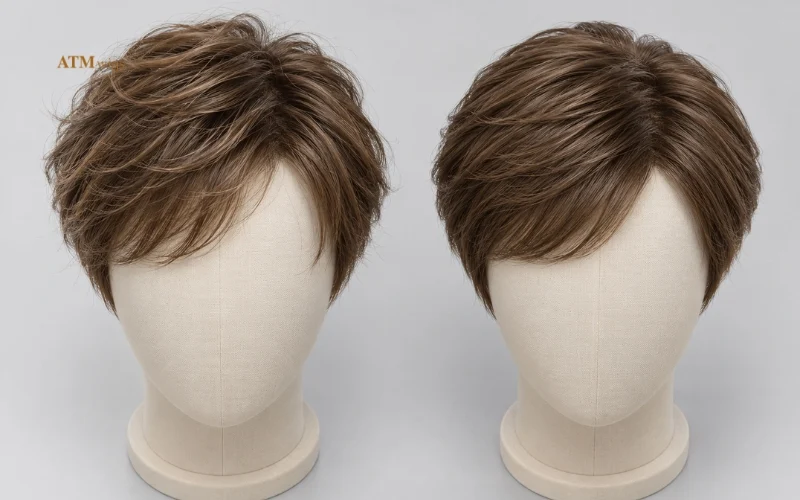
What are human hair and synthetic toupees?
Human hair toupees
A human hair toupee is a partial hairpiece made with real human hair. It is designed to cover areas such as the top or crown while blending with the hair that remains around the sides and back.
Human hair can be cut, directed, curled, or straightened to coordinate with an existing hairstyle. Texture still varies with sourcing and processing.
Synthetic toupees
A synthetic toupee uses manufactured fibers designed to imitate natural hair. Different fiber formulations produce different levels of softness, shine, texture, and heat tolerance.
Many synthetic toupees are manufactured with a preset shape that remains relatively consistent after washing. Some use heat-friendly fibers, but this does not mean they can be treated exactly like human hair.
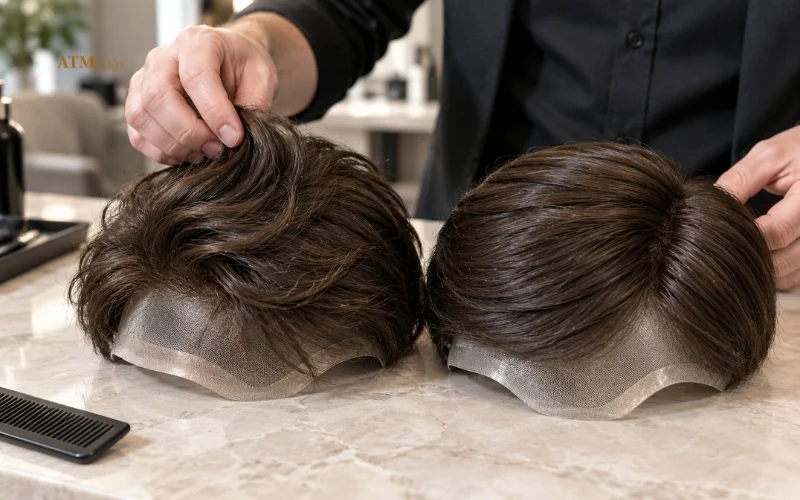
Key differences between human hair and synthetic toupees
Natural appearance and hair movement
Individual strands of human hair usually differ slightly in thickness, in the way they reflect light, and in the way they move. It responds to brushing and direction changes much like the hair growing around it, which can make a short men’s haircut look less uniform.
Synthetic fibers can look convincing, too, especially if the finish is matte or naturally lustrous, rather than too shiny. Some fibers, however, are more evenly distributed or more tightly bound than human hair.
Differences may become noticeable in daylight or motion, although quality and matching can matter more than fiber type.
Blending with your existing hair
Blending is particularly important for toupees because the hair at the sides and back remains visible. A convincing result depends on matching texture, strand thickness, color, gray percentage, and the way the hair falls.
Human hair offers more flexibility when a stylist needs to soften a transition or change the direction of the top hair. For example, a slight natural wave can often be adjusted to flow into a similar wave at the temples.
Synthetic hair can blend well when the chosen fiber closely matches the surrounding hair from the start. Its preset texture can be harder to adjust as natural hair grows or changes shape.
For either material, check samples against your hair in natural light. A close color match alone will not correct a noticeably different curl pattern or level of shine.
Styling flexibility and heat tolerance
Human hair toupees are generally the more adaptable option for people who change their hairstyle. With appropriate products and moderate heat, the hair can be blow-dried, curled, or straightened. Professional coloring may also be possible, depending on previous processing.
Excessive heat and repeated chemical treatments can weaken strands that cannot regrow once attached.
Conventional synthetic fibers usually do not tolerate heated tools. Heat-friendly synthetic toupees allow some restyling, but only within the fiber manufacturer’s stated temperature range and instructions.
Synthetic hair is therefore often more suitable for a wearer who wants the same carefully chosen shape each day rather than frequent changes in parting, wave, or volume.
Daily maintenance and style retention
Human hair behaves more like growing hair after washing. It may need detangling, conditioning, and blow-drying or other restyling to recreate the desired finish. Moisture and humidity can also affect its shape.
Synthetic toupees typically come with a set curl or wave and require less daily styling. This can be a plus if you’re someone who likes to have a predictable morning routine or doesn’t use styling tools very often.
However, lower styling effort does not mean zero maintenance. Synthetic fibers can frizz or tangle from rubbing against hats, bedding, and clothing, and ordinary heat may not safely restore damaged strands.
Both materials need gentle handling. The main difference is recreating a style versus preserving a preset one.
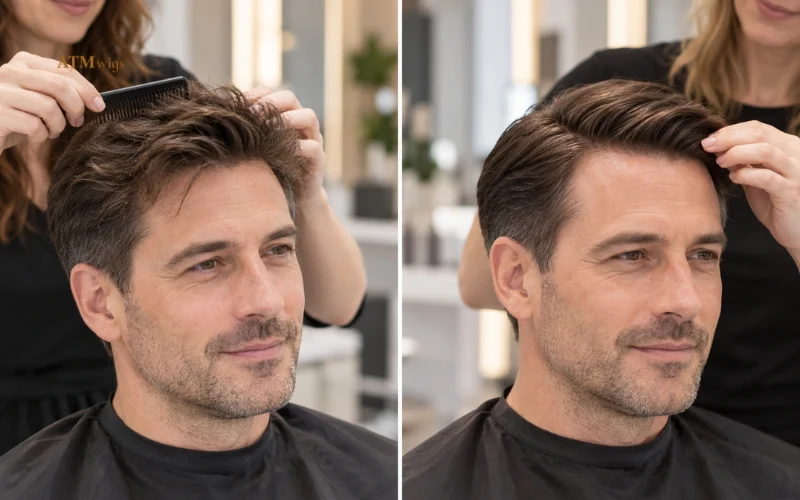
Durability and expected lifespan
There is no reliable universal rule that every human hair toupee lasts longer than every synthetic one. Quality of hair, processing, friction, frequency of wear and care habits can make a huge difference in the outcome.
The human hair can be restyled as it changes its look. It can lose its softness or color gradually. Synthetic hair may hold its intended shape well yet develop persistent frizz, roughness, or heat damage that is difficult to reverse.
The lifespan of the complete toupee also depends on its base, regardless of fiber type. When comparing products, ask how the hair is expected to age under your actual wearing routine rather than relying on a single lifespan claim.
Initial cost and long-term value
The cost of buying human hair toupees is generally higher because the price of the raw materials is affected by the sourcing, sorting, processing and customization of real hair. Synthetic fibers often make a lower entry price possible.
That does not mean the least expensive option is automatically better value. If you find a style that fits your routine, you can save money by getting synthetic hair, but human hair may be worth the cost if you want realistic movement and frequent restyling.
Consider replacement needs and care. For details, see how much toupees cost.
Which is better for you: Human hair or synthetic toupees?
When to choose human hair toupees
Human hair is often a good match if your priority is a natural transition between the hairpiece and your existing hair. It is particularly useful when you wear a textured or brushed-back style that needs movement and a customized finish.
It also suits wearers who enjoy changing their look and do not mind conditioning and restyling the hair. The extra flexibility is most valuable when you will actually use it.
When to choose synthetic toupees
Synthetic hair deserves consideration if you prefer a consistent hairstyle that needs little reshaping from day to day. It can work especially well when a ready-made texture already matches your natural hair closely.
It may also appeal to people working within a lower initial budget. Before selecting it, make sure you are comfortable with the fiber’s limits on heat, color changes, and future restyling.
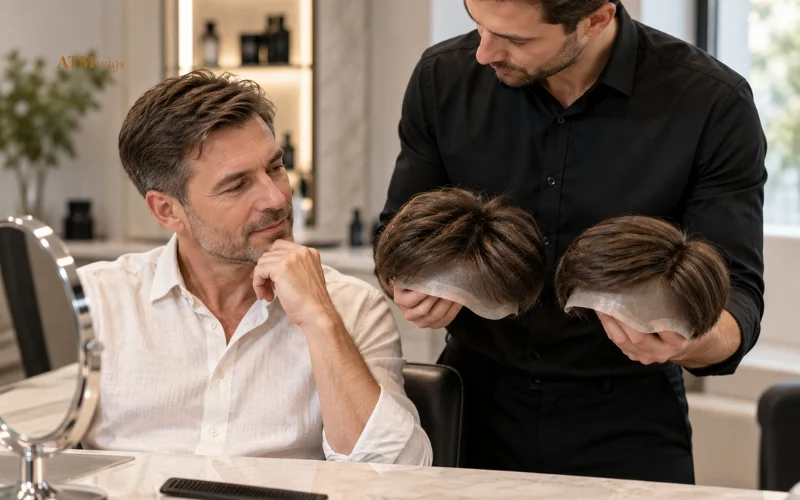
FAQs about human hair vs synthetic toupees
Which looks more natural, human hair or synthetic toupees?
Human hair often has the advantage in natural movement and shine variation. But premium synthetic fibers can look real, too. The best option is the one that would match your remaining hair in texture, density, color and finish.
Which type blends better with existing hair?
Human hair is typically easier to adjust when you need to match the direction or wave of hair around the sides and back. Synthetic toupees can blend equally convincingly when their preset texture and shine are already a close match.
Do human hair toupees last longer than synthetic toupees?
Not always. Longevity depends on material quality, wear frequency, friction, styling and care. Human hair is more forgiving in terms of restyling, but synthetic fibers will hold their preset shape; either can wear out or need replacing over time.
Can synthetic toupees be styled like human hair?
Not in the same way. Most conventional synthetic hair is not intended for hot tools or chemical coloring. A heat-friendly synthetic toupee may allow limited reshaping, but you must follow its specific temperature limits.
Are human hair toupees worth the extra cost?
They can be if you want flexible styling, natural movement and close blending. If you want a stable, low styling look, a well matched synthetic toupee might be better value for you.
The right choice in human hair vs synthetic toupees depends on blending, styling freedom, upkeep, and budget. Explore ATM Wigs’ toupee collection or toupee catalog to compare options for your preferred look.

