

Knowing how to measure for a toupee helps you avoid a base that leaves thinning areas exposed or overlaps healthy hair. Follow these five steps to find your coverage area, measure accurately and validate your results before you order.
Quick answer: Mark the lines for the desired front hairline and the boundaries of the coverage area. Measure from front to back along your scalp, then across the widest point from side to side. Record both measurements and check the base shape.
What measurements do you need for a toupee?
A toupee usually does not cover the whole head, but only the part where hair is missing. To determine your toupee base size, you will need two measurements, length from front to back and width from side to side.
Front-to-back length
Length runs from the center of your planned front hairline to the rear boundary of the coverage area. It may extend over the top and toward the crown.
Follow the curve of your scalp with a flexible tape. Base length is different from the length of the hair attached to the toupee.
Side-to-side width
Width is the distance between the left and right edges at the widest point of the planned coverage area. That point may be near the crown, not directly behind the front hairline.
Measure along the scalp rather than through the air. These dimensions describe approximate size, while the outline helps determine the appropriate base shape.

What do you need before measuring your toupee size?
You can take basic hair system measurements at home with:
- A flexible measuring tape marked in inches and centimeters
- A large mirror and handheld mirror
- A skin-safe washable pencil
- A phone camera to check the crown
- Notes for recording the results
Begin with clean, dry hair arranged as you normally wear it. Use good lighting to distinguish bare patches from areas of sparse hair.
If the back of your head is difficult to see, ask someone to help. Guessing the rear boundary may affect both measurements.

How to measure for a toupee step by step
Define the area needing coverage before measuring. Use the same marked boundaries throughout these five steps so your measurements remain consistent.
Step 1: find and mark your natural front hairline
Stand in front of a mirror and find out where you want the front edge of the toupee to start. Try to use your temple hair, features and whatever other signs of your original hairline you have left.
Not very low. A hair system will be more noticeable if the hairline is too straight or too low.
Lightly mark the center with a washable pencil and draw the front contour. Stop and look at the placement in a straight on photo before you go on.
Step 2: outline the area that needs coverage
Look at the front, top and crown from different angles. Mark where hair is missing or too sparse to give you the coverage you want.
Follow the thinning area without unnecessarily including strong surrounding hair. Healthy side and back hair can help the finished toupee blend with your hairstyle.
Check the crown with a mirror or photo. The rear boundary may extend farther than you can see from the front.
You do not need to shave your scalp to take these measurements. If the edges are not clear, get professional fitting advice.
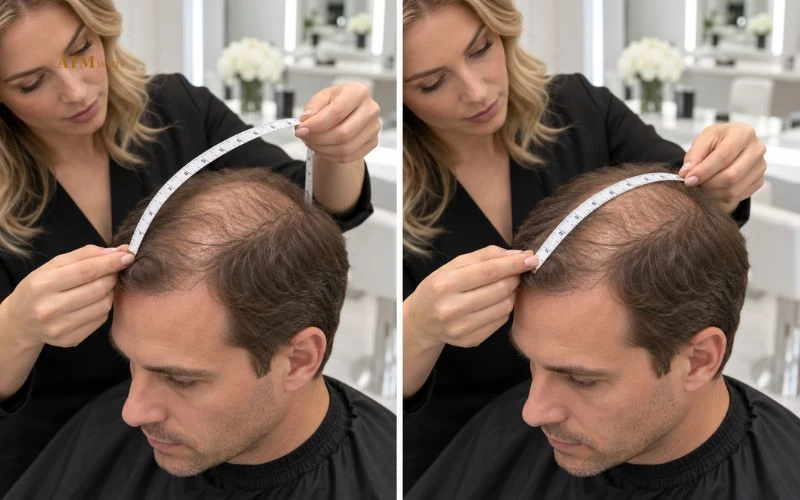
Step 3: measure the front-to-back length
Place the zero end of your tape at the middle of the marked front hairline. Draw it over the top of your head to the marked back boundary.
Place the tape softly on the natural curve of your scalp. Do not stretch the tape tight or put it over your head.
Read and record the result. For example, your base length might be 10 inches (25.4 cm).
Again measure along the same path. If the readings differ, check the tape position and the boundary marks. Then decide on a final number.

Step 4: measure the side-to-side width
Locate the widest part of the outlined area. Depending on your hair loss pattern, this may be near the middle of your scalp or toward the crown.
Run the tape from the left boundary to the right boundary across that point. Keep it in contact with your head’s curve.
You might record a width of 8 inches (20.3 cm). This is an illustrative example, not a universal recommendation.
Repeat to confirm the measurement. Do not automatically measure above the ears; follow your actual coverage area.
Step 5: double-check and record your measurements
Check your outline from the front, both sides and overhead. Make sure you cover any thinning areas without being too heavy over strong natural hair.
Repeat the length and width measurements from the same start and end points. If the area is round, oval, or irregular, take note.
For example, your record might include:
| Measurement | Example |
|---|---|
| Front-to-back length | 10 in / 25.4 cm |
| Side-to-side width | 8 in / 20.3 cm |
| Coverage area | Front, top, and crown |
| Shape | Oval |
Save a photo of the outline with your measurements. Confirm whether your supplier lists sizes as length × width or width × length.
How to choose the right toupee base size
Compare your results with the supplier’s toupee size guide. Check its measuring method, units, and base shape rather than relying only on a size label.
Matching your measurements to a stock toupee
Stock bases come in set dimensions. Some can be professionally trimmed, but this depends on the construction, front hairline, and crown position.
Do not assume a larger base can always be cut down safely. Ask the supplier before choosing a size that exceeds your marked area.
When should you consider a custom-sized toupee?
If the coverage area is asymmetrical, irregular or difficult to match with standard sizes, consider a custom base. Custom fit may require more than just length and width of your scalp contour.

Do you need a scalp template for accurate toupee measurements?
A scalp template is not always needed for a stock toupee. It becomes helpful when your coverage area has an irregular outline or curvature that basic measurements cannot describe.
For a custom system, follow your supplier’s instructions for creating and labeling the template. At this stage, the priority is to record the coverage dimensions accurately, not to complete the entire template-making process.

Common mistakes to avoid when measuring for a toupee
Small errors can affect coverage and fit. Use these checks before ordering:
| Common mistake | Better approach |
|---|---|
| Measuring the whole head | Measure only the intended coverage area |
| Placing the hairline too low | Check temple hair and facial proportions |
| Lifting the tape off the scalp | Follow the head’s natural curve |
| Missing thinning at the crown | Check photographs from above and behind |
| Taking only one reading | Repeat length and width |
| Assuming any base can be cut | Confirm trimming options with the supplier |
Remember: accurate numbers cannot correct a poorly marked coverage area.
FAQs about measuring for a toupee
How do I know what size toupee I need?
Measure the front-to-back length and widest side-to-side width of the area requiring coverage. Compare both with the supplier’s base specifications, then check the outline. If unsure, share your measurements and photos with a fitter.
Do I need to measure my entire head for a toupee?
Usually not. A toupee generally covers the front, top or crown as the natural hair is left around the sides and the back. Head size is more suitable for full cap wigs or systems that cover most of the scalp.
What if my measurements fall between two toupee sizes?
A slightly larger stock base may work if the supplier confirms that trimming is safe. Different lace and skin constructions have different limitations. Consider custom sizing when neither available base matches your outline.
Can I measure for a toupee by myself?
Yes. Usually a flexible tape, but mirrors and photos are enough for basic measurements. Having another person can assist with accuracy around the crown, particularly with finding the rear boundary or keeping the tape on the correct track.
Can I measure my existing toupee to find my size?
Yes, if the fit is good. Measure its base without deforming or stretching the material. Compare those dimensions to your current hair loss area as you may have changed the coverage you need since you last bought.
How often should I remeasure my toupee size?
Re-measure if your hairline, hair loss area or desired coverage changes. Even if you’re buying the same model again, checking the dimensions can help you make sure that your old size still fits your needs.
By knowing how to measure for a toupee you’ll be able to choose a base that covers the right area and blends with your hair. See the ATM Wigs toupee collection or contact ATM Wigs to discuss suitable options.

