

Human hair toupees generally can be colored, particularly if darkening a color or refreshing a faded color. The hair, base and knots however demand more careful treatment than biological hair. This guide will show you how to dye a toupee safely with minimal chances of staining, dryness and uneven color.
Can you dye a toupee?
Most human hair toupees can be colored with permanent, demi-permanent, or semi-permanent dye. For routine color refreshing, a gentle demi-permanent or deposit-only formula is often the safer choice.
Toupee hair may already have been bleached, colored, or chemically processed during production. Previous treatments can increase porosity which can lead to the pigment absorbing faster or unevenly than expected.
High-quality Remy Hair may remain smoother and easier to manage during careful color adjustment. However, the final result still depends on the hair’s porosity, processing history, and current condition.
Regular human hair dye should not be used on synthetic toupees. Synthetic fibers may remain unchanged while the lace, monofilament, or skin base becomes stained.
Blended systems can also develop uneven color because the human hair may darken while the synthetic strands retain their original shade. Always confirm the fiber type before coloring.
Before you dye a toupee
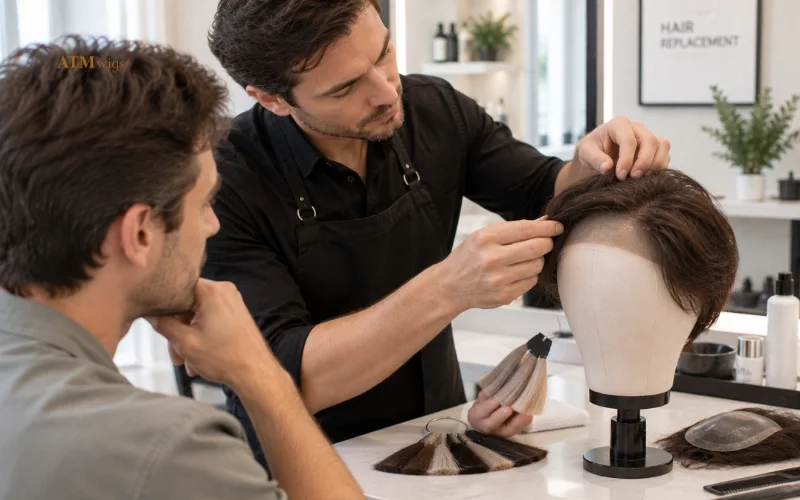
Check the condition of the hair before preparing the dye. Avoid coloring a toupee that is extremely dry, brittle, heavily tangled, or already shedding excessively.
Gently stretch a damp strand from a hidden area. If it breaks easily or feels unusually elastic, the hair may not be strong enough for further chemical processing.
You should also identify the base material. Lace and monofilament are dye receptive; poly skin and PU portions may exhibit surface staining. If the product is applied too close to the base, exposed knots may darken.
Is it better to go darker or lighter?
It is generally safer to darken a human hair toupee one or two shades than to remove existing pigment. A demi-permanent color or gloss may be enough to restore a faded brown, blonde, or red shade.
Bleaching carries a higher risk of dryness, breakage, loose knots, and base damage. Significant lightening, highlights, or complex color correction should be completed by a professional familiar with human hair systems.
How to choose the right shade
Compare the toupee with the wearer’s biological hair in natural daylight. Match the overall shade and mid-lengths rather than looking only at the roots.
Consider the undertone as well as the color level. Ash, neutral, golden, and red tones can look noticeably different even when they have a similar depth.
If you are in doubt and torn between two shades, the lighter shade is generally safer. Porous toupee hair can pick up color fast and can be darker than the color chart.

What you need
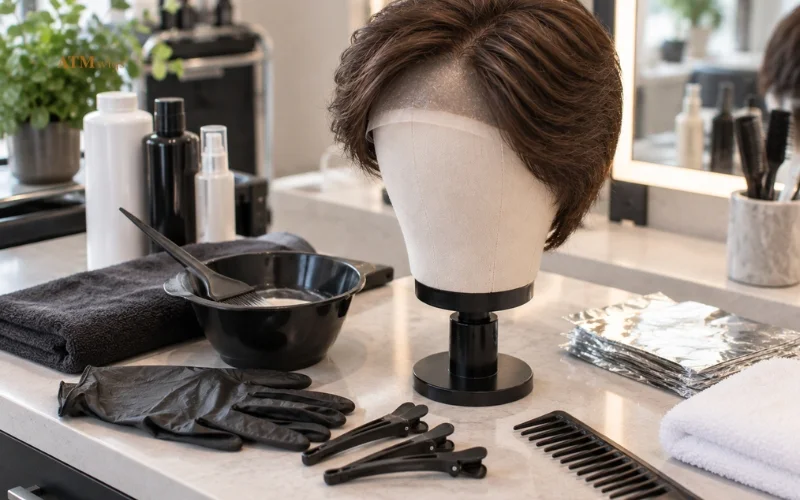
Prepare all the necessary tools before mixing the color:
- Hair color suitable for human hair
- Compatible developer, if required
- Non-metallic mixing bowl
- Small tint brush
- Disposable gloves
- Sectioning clips
- Wide-tooth comb
- Plastic wrap or foil
- Base-safe barrier cream for lace or PU
- Old towel
- Wig stand or mannequin head
- Color-safe shampoo and conditioner
- Timer
Always follow the color manufacturer’s mixing and safety instructions. Do not use a stronger developer or extend the processing time to force a faster result.
How to dye a toupee in 7 steps
Always remove the toupee before coloring it. It is hard to apply accurately when wearing the system and exposing your scalp, base and adhesive areas to chemicals.
Step 1: Clean the toupee
Use a mild shampoo to remove oils, styling products and residue from human hair systems. Buildup can inhibit the dye from developing evenly.
Support the base and rinse in the directions of the hair. Do not rub, twist or wring out the system.
Avoid heavy conditioners right before coloring because it can coat the strands and minimize color absorption.
Step 2: Perform a strand test
Pick a small area on the back of the toupee in a hidden area. Apply intended color formula, noting time taken to achieve desired shade.
Rinse and dry the test strand thoroughly. Look for hair softness, strength and elasticity besides the final color.
A strand test predicts the color result and shows how the hair responds to the formula. Follow the dye manufacturer’s instructions for a separate skin patch test before handling and applying the product.
Step 3: Protect the base and knots
Place foil or plastic beneath the section being colored. This helps prevent dye from passing through the hair and staining the base.
If necessary, apply a very thin layer of base-safe barrier cream to the underside of the lace or PU. Keep the cream away from the hair and knots because coated strands may not absorb the dye properly.
Protect PU edges, clips, and areas used for tape or adhesive. Do not brush or press dye directly into exposed knots.
Step 4: Section and prepare the color
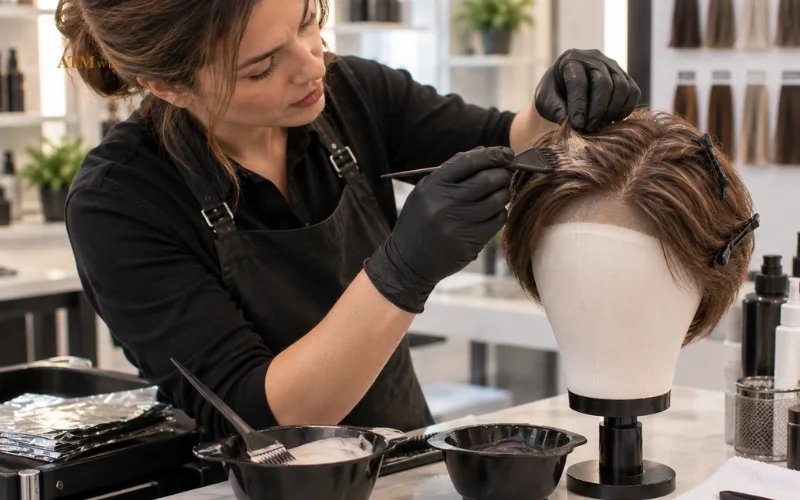
Put the toupee on a clean wig stand or mannequin head. Carefully pin it without breaking the fine lace unnecessarily.
Comb through hair with a wide tooth comb, detangling from the ends upward. Divide it into at least four manageable parts for more accurate application.
Mix the color in a non-metal bowl to the exact ratio that the manufacturer states. Prepare enough product to cover target areas in an even manner.
Step 5: Apply and monitor the dye
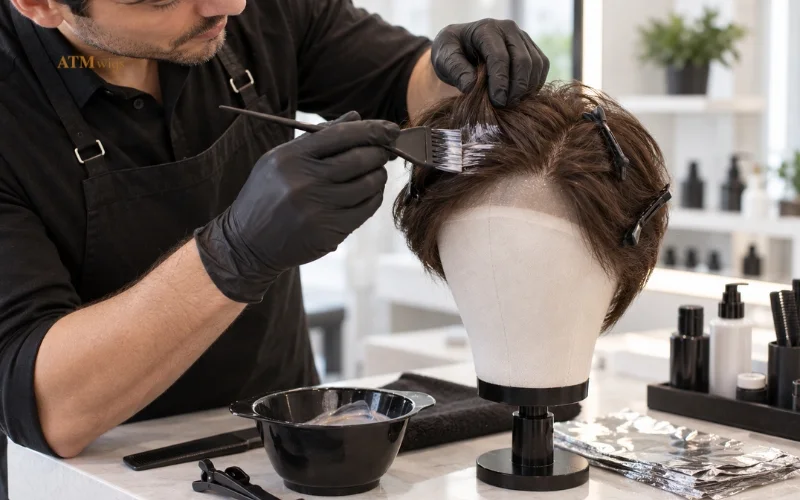
Work on thin sections and apply dye with small tint brush with light down strokes. Start in the area that needs the most color correction.
Leave a small gap between the dye and the base whenever possible. Avoid oversaturating short root areas or forcing the product through the hair and onto the knots.
The ends are often more porous than the rest of the toupee. Apply less dye to them or include them later in the process to prevent an overly dark result.
Use the strand test as a guide to regularly check the color. Do not exceed the maximum processing time indicated by the manufacturer.
Step 6: Rinse carefully
Rinse under cool or lukewarm water while supporting the base. Guide the water from the roots to the tips to avoid tangling.
Do not soak, scrub or wring the hair. Continue to rinse until the water runs clear and you can no longer see any dye on the base.
Keep the hair constantly flowing in one direction. This will reduce friction and help to protect the knots.
Step 7: Condition and dry
Use a color safe, lightweight conditioner on mid-lengths to ends. Keep heavy conditioner away from the base, knots, and attachment areas.
Blot away excess water with a microfiber towel without twisting the hair. Detangle gently from the ends upward and allow the toupee to air-dry on a suitable stand.
Assess the final shade only after the hair is completely dry because wet hair normally appears darker.
Limit heat styling and wash your system only when necessary after coloring to minimize fading and dryness. When using heated tools, use heat protection.
Common toupee dyeing mistakes
Avoid these six common mistakes:
- Using regular hair dye on synthetic fibers
- Skipping the strand test
- Selecting a shade that is too dark
- Applying dye directly to the base or knots
- Using a stronger developer than necessary
- Leaving the color on longer than recommended
These errors may cause uneven color, base staining, dryness, breakage, or increased shedding.
How to fix common color problems
The color is too dark
Do not apply bleach at this time. Let some gentle washing take away a little of the pigment or speak to a professional about controlled color correction.
Do not use aggressive clarifying agents unless they have been proven to be suitable for the system.
The color looks uneven
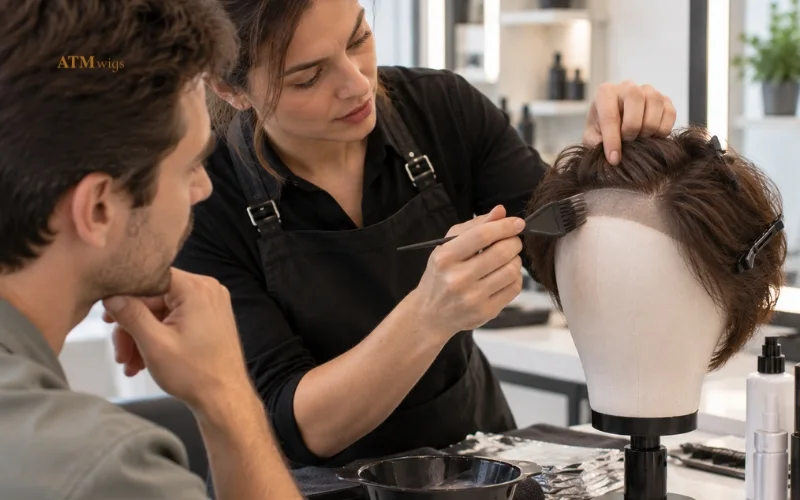
Inconsistent color can be caused by product build-up, uneven application, porous ends or previous chemical processing.
Some areas may require different formulae or processing times. Where the contrast is great, professional correction is recommended.
The base is stained
Blot and rinse the stain immediately. Never scrub delicate lace or use chlorine bleach, alcohol or strong stain removers.
Only use cleaning products known to be safe on the base material. Aggressive cleaning may stretch lace, damage PU, or loosen knots.
When to use a professional colorist
Professional assistance is recommended when the toupee requires bleaching, highlights, gray blending, or a change of more than two color levels.
A specialist should also handle dry or damaged hair, delicate lace bases, previous uneven color, and valuable custom systems. Professional correction may prevent damage that is difficult or expensive to repair.
FAQs about how to dye a toupee
Can you dye a toupee darker?
Yes. Darkening a human hair toupee is usually safer and more predictable than making it lighter. Complete a strand test because porous hair may produce a darker result than expected.
How long should dye stay on a toupee?
Follow the product manufacturer’s processing time and use the strand test as your guide. Previously processed toupee hair may absorb color faster than biological hair.
Can hair dye stain a lace toupee?
Yes. Dye can pass through the hair and stain the lace or darken exposed knots. Apply it with a small brush, protect the underside, and avoid oversaturating the roots.
Can you bleach a human hair toupee?
Some human hair toupees can be bleached, but this can weaken the hair, knots and base. Lightening should be executed professionally.
Knowing how to dye a toupee safely helps preserve its hair quality, knots, base, and natural appearance. Salons, retailers, and hair replacement professionals can explore ATM Wigs’ premium human hair toupees or contact our team for custom color and product development support.

