

How do toupees work? They take a fitted base with hair attached and put it over the area of hair loss. The base is attached to your scalp or existing hair and cut and blended to look natural.
What is a toupee?
A toupee is a partial hairpiece designed to cover localized hair loss, usually at the front, top, or crown. Unlike a full wig, it replaces hair only where coverage is needed and leaves the surrounding biological hair visible.
Modern toupees are also called men’s hair systems, hairpieces, or non-surgical hair replacement systems. They may be made with human hair, synthetic fiber, or a blend of both.
A toupee does not regrow biological hair. It provides immediate cosmetic coverage by filling the thinning or bald area and integrating with the wearer’s remaining hair.
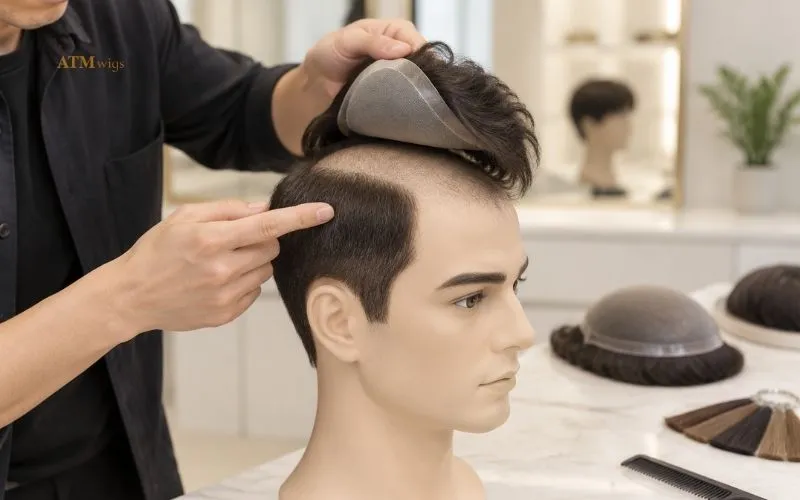
How do toupees work?
A toupee is comprised of three interrelated components; a base that fits the area that needs coverage, hair that is attached to the base and an attachment method that keeps the system in place.
Step one is to determine the area that is thinning or balding. Then a stock or custom base is made to a suitable shape and size to cover that area without unnecessarily extending over healthy hair.
Then the base is attached with double-sided tape, liquid glue, clips, or a combination of these. The extra hair is then trimmed and blended with the surrounding biological hair.
The finished toupee is worked into a complete hairdo. How well and how comfortably it performs will depend on the base fit, hair construction, attachment, color match, density and cut-in.
The base provides the coverage
The base is the foundation that holds the added hair. It sits over the thinning or bald area. The way it is constructed influences how the toupee attaches, feels and looks on the scalp.
Air can flow through lace and can create a light, less visible edge around the hairline. Polyurethane creates a smooth surface for tape or a liquid adhesive and can lay flush against the skin.
Monofilament adds structure and hybrid bases use more than one material in different areas. For example, a system may use lace at the front for a natural hairline and polyurethane around the perimeter for attachment.
Whatever the material, the base must match the coverage area accurately. An incorrect size or shape can create visible edges, poor alignment, or difficulty blending the system with existing hair.
Hair is secured to the base
The individual strands are attached to the base by means such as knotting, injection or looping. This process is often referred to as ventilation.
Ventilation controls the direction and distribution of the hair. It enables the toupee to be styled in various ways, including side part, forward fringe, textured crop, or brushed-back look.
Hair can be ventilated in a defined direction or arranged for freestyle movement. The chosen direction should support the intended haircut and the natural growth pattern of the wearer’s remaining hair.
The hair density also needs to be balanced. If the toupee is significantly fuller than the biological hair around it, the transition may look obvious even when the attachment is secure.
The toupee blends with existing hair
A toupee must integrate with the hair surrounding the coverage area. It should not look like a separate layer placed on top of the head.
The added hair is cut to coordinate with the wearer’s natural length, density, texture, and growth direction. Excess bulk may be removed around the perimeter to create a smoother transition.
Color matching is the overall shade, root tone, gray percent, highlights and undertones. Hair texture and curl pattern must also be compatible with the surrounding hair.
When the base, hair construction, and cut-in work together, the visible boundary becomes less noticeable. The toupee appears to continue naturally into the wearer’s biological hair.
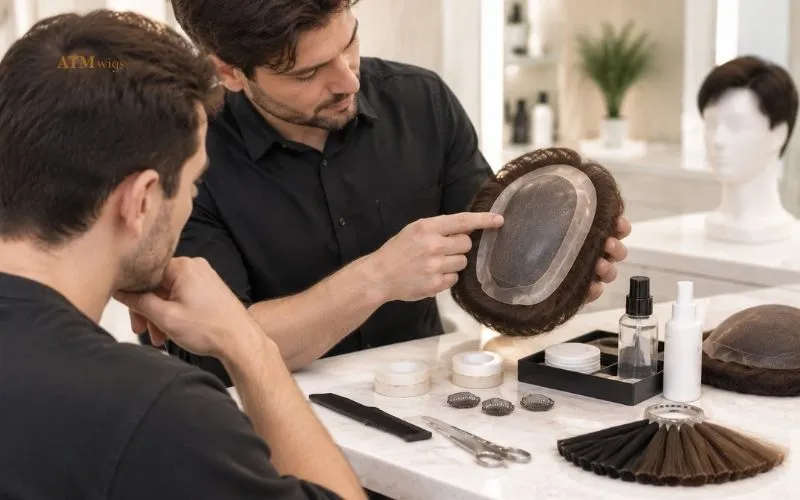
How do toupees stay on?
Toupees stay on using tape, liquid adhesive, clips, or a combined attachment method. The best choice depends on the base material, scalp condition, remaining hair, activity level and schedule of wear preferred.
Attachment performance can also be affected by scalp oil, sweat, humidity, temperature, and maintenance habits. No method provides exactly the same hold for every wearer.
Toupee tape
Toupee tape is double-sided. One side attaches to the underside or perimeter of the base, while the other adheres to a clean, prepared scalp.
Different tapes are designed for different levels and durations of hold. Some support short-term attachment, while others are intended for longer wear when compatible with the selected base and skin.
Tape can be relatively easy to position and remove. But oil, sweat, heat and sticky stuff can gradually break down the bond.
Liquid adhesive
Liquid adhesive creates a close bond between the scalp and the appropriate part of the base. It is often used around an exposed front hairline, where a smooth and discreet attachment is particularly important.
The adhesive is applied in a controlled layer and permitted to come to a bonding condition. Since drying and curing times vary, always follow the instructions that come with the particular product.
The adhesive has to be compatible with the base and the wearer’s skin. If you have sensitive skin, you might need to do a patch test before using a new product.
During removal, a compatible release product should be used to loosen the bond. Pulling the base away forcefully may stretch delicate materials or irritate the scalp.
Toupee clips
Toupee clips attach to biological hair around the coverage area. They allow the hairpiece to be applied and removed without bonding the entire base directly to the scalp.
This method requires enough healthy hair to support the clips. It may not be suitable when the surrounding hair is very fine, fragile, or sparse.
Because clips concentrate tension in specific areas, their placement should be monitored. Repeated pulling in the same location may place unnecessary stress on biological hair.
Combined attachment
Some toupees use more than one attachment method. A liquid adhesive can be used to secure the front hairline and tape can be used along the sides and back for hold.
Natural hair clips may be added if there is enough. A combination approach can offer targeted security, but all components must still be appropriate for both the base and the wearer.
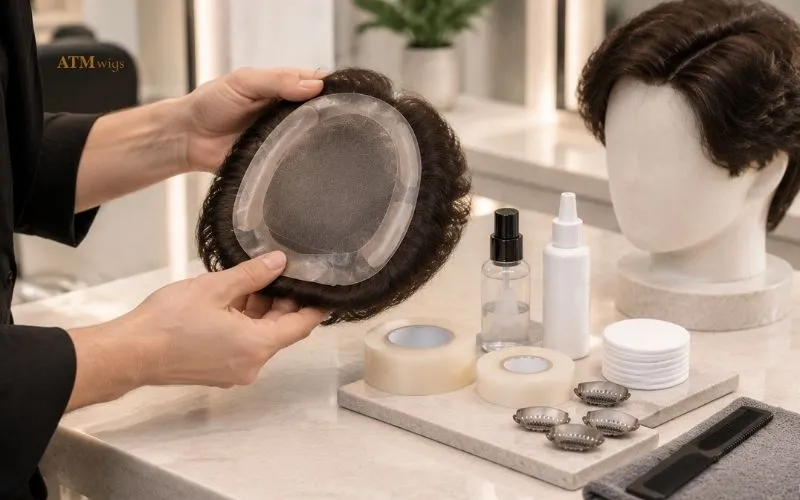
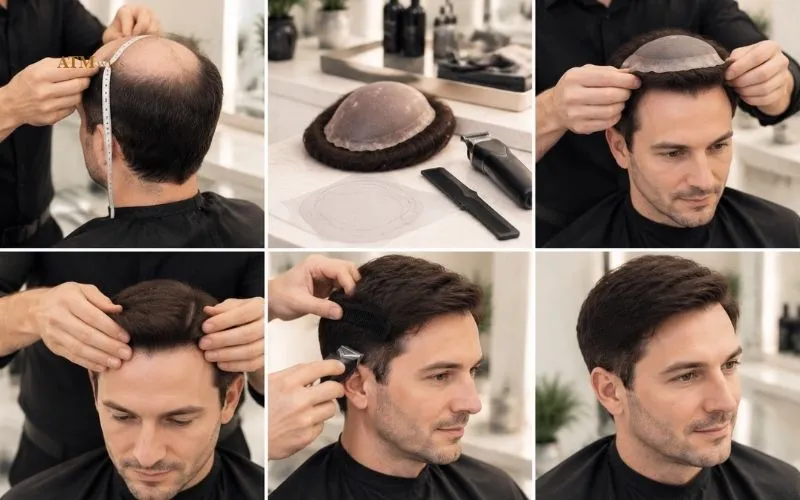
How is a toupee fitted and installed?
You start the installation by determining the precise area to be covered. This can be the front hairline, top, crown or a combined area of the upper scalp.
To find the area, the base dimensions are measured. A template can be made for a custom hair system to more closely match the shape and curvature of the scalp.
Preparing the attachment area
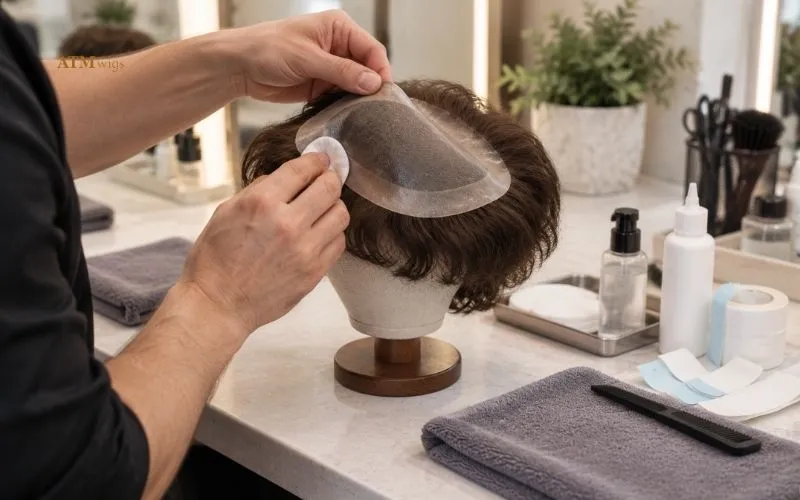
The scalp should be clean, free of oils, sweat and any styling residue before the application of tape or adhesive. Properly preparing the surface helps the attachment to bond more consistently.
In some cases the hair under the base will need to be shaved or trimmed for bonded systems. This provides a smooth attachment area and prevents biological hair from catching in the adhesive.
However, not every toupee requires shaving. Clip-on and certain temporary systems may attach without it when enough suitable biological hair remains.
Positioning and attaching the base
The base is aligned with the intended hairline and centered over the coverage area. Its position should be checked carefully before completing the attachment.
Once aligned, the toupee is applied gradually to reduce wrinkles, uneven tension, and trapped hair. The base should lie smoothly against the head without lifting around the perimeter.
Hairline placement is especially important. Positioning it too low, too high, or unevenly can make the toupee appear unnatural regardless of the hair quality.
Cutting and blending the hair
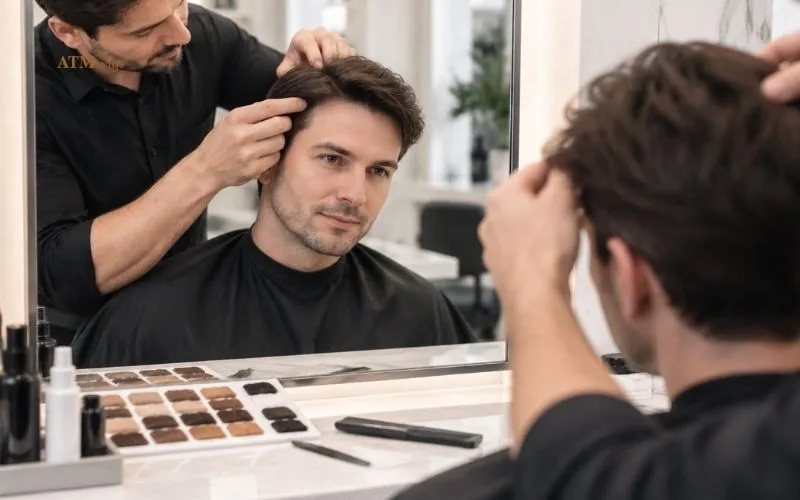
Many new toupees contain extra length and density so they can be customized. The final cut is normally completed while the system is positioned on the wearer’s head.
During the cut-in, the stylist adjusts the shape, volume, and perimeter. The added hair is connected visually with the biological hair at the sides and back.
This step turns the toupee into a full head of hair, not just a hairpiece. Professional fitting and cut-in are especially helpful for first time wearers.
Why can a toupee look natural?
A modern toupee can look natural because its construction recreates the appearance of hair growing from the scalp. A thin, correctly fitted base reduces the visible boundary between the system and skin.
At the front, graduated density creates a softer hairline instead of a thick, perfectly uniform row. Appropriate ventilation also allows the hair to fall in a believable direction.
The density should coordinate with the wearer’s age, hairstyle, and remaining hair. Choosing excessive volume can make the coverage area look disconnected from the sides and back.
Color and texture complete the integration. The transition is less apparent in varied lighting when the root tone, gray percentage, curl pattern, and hair thickness are compatible.
A sharp cut-in ties these details together. Natural appearance is therefore created by the full system—not by the base, adhesive, or hair alone.
How does a toupee work during daily wear?
A properly fitted and attached toupee should remain stable during ordinary daily activities. The wearer may initially notice the base or bond, but the sensation often becomes less prominent with familiarity.
Some bonded toupees can remain attached during sleeping, showering, and exercise. Daily-wear systems are instead removed and reapplied according to their attachment design.
Heat, perspiration, moisture, and scalp oil can gradually affect the bond.More frequent maintenance may be required by active wearers or those living in humid climates with attachments.
New glue might also have to cure before being exposed to water or heavy perspiration. Follow the instructions for the particular tape or liquid adhesive.
A toupee is secure when its fitting, attachment products, and maintenance schedule work together. Even a strong adhesive cannot compensate for poor scalp preparation or an incorrectly fitted base.

How are toupees removed and reapplied?
Toupees must be removed periodically so the scalp and base can be cleaned. The interval will depend on whether the system is for daily, short term or extended wear.
For tape or adhesive, loosen with a compatible release product. Carefully lift the base to protect the skin and delicate base materials.
The base is freed of residual attachment products and the scalp is cleaned thoroughly. Make sure both surfaces are dry before applying any new tape or adhesive.
The system is also inspected for loose hair, raised edges or damage to the base. It can then be repositioned to the established hair line and area of coverage.
This removal, cleaning, inspection and reapplication process keeps the attachment functioning properly. It also helps to prevent build-up on the scalp, base and finished look.
FAQs about how toupees work
How do toupees attach to the head?
Toupees are attached with double-sided tape, liquid adhesive, clips or a combination of these. The right choice depends on your base material, scalp, hair left, lifestyle and desired wear time.
Do you have to shave your head for a toupee?
Not always. Bonded systems may require the covered area to be shaved, while clip-on or temporary systems can sometimes attach without shaving when enough suitable hair remains.
How long does toupee adhesive hold?
Hold time varies according to the adhesive, scalp oil, perspiration, climate, activity level, and application quality. Product instructions and the condition of the bond should guide reapplication.
Can a toupee fall off?
A properly fitted and securely attached hairpiece should stay in place during normal use. Poor scalp preparation, weak adhesive, heavy perspiration, or delayed maintenance can reduce hold.
Does a toupee affect natural hair growth?
A toupee covers the scalp but hair can not grow back. Proper fitting and gentle removal can protect surrounding hair . Pulling the clip too tight or removing the glue incorrectly can cause tension .
What do toupees do? Fitted base, ventilated hair, secure attachment and precise blending for natural partial coverage. Check out the catalog to find a human hair toupee from ATM Wigs that suits your coverage and styling requirements.

