


If you’re asking how do you know if a wig is synthetic, you probably want a clear answer without damaging the hair. This guide stays focused on identification: quick no-tool checks, what to look for inside the cap, and the most reliable differences versus human hair.
Why it matters (heat, products, lifespan)
Understanding whether a wig is synthetic can help avoid many common errors. The most common area of error is with heat; some synthetic fibers may lose their shape or melt when heated by styling tools.
It also affects product choice. Synthetic fiber usually works best with lightweight, anti-static-friendly products, while human hair behaves more like natural hair and often needs moisture-focused care.
Finally, fiber type changes lifespan expectations. Synthetic wigs tend to hold their preset style well but can frizz faster at friction points, while human hair usually offers more natural movement over time.
If you also want the deeper “materials” explanation, keep this article focused on identification and check: what is synthetic hair made of.

Quick checks you can do at home (no tools)
These checks are fast, safe, and don’t require heat tools or special equipment. For the most accurate answer, use at least two checks together.
Check 1: Shine in natural daylight
Stand near a window and look at the wig in soft daylight. Many synthetic wigs reflect light more evenly, which can create a slightly “too glossy” finish.
Human hair usually shows a more irregular, natural-looking shine. Highlights won’t look identical across every section.
Premium synthetic wigs can be less shiny than older fibers, so treat shine as a strong clue – not a final proof on its own.
Check 2: Texture consistency from root to ends
Gently separate a section and feel the strands. Synthetic fiber often feels very uniform, with the same texture throughout.
Human hair usually has small variations. Even well-processed human hair rarely feels perfectly identical strand-to-strand.
If the wig feels waxy or coated, it may be product buildup rather than fiber type. In that case, rely more on the inside-tag check and the mist test below.
Check 3: Rub test (slip, static, and “squeak”)
Using your fingers to rub a small area with light pressure will help you determine whether the material is synthetic or not. Synthetics are usually quite slippery and will produce static electricity, especially during dry weather.
Some synthetics also have a faint “squeak” or coated feel when rubbed. Human hair tends to feel more hair-like and less uniformly slippery.
Static alone doesn’t prove synthetic, but static plus uniform texture plus extra shine is a common pattern.
Check 4: Frizz and tangle behavior at friction zones
Look at the nape area and behind the ears – places that rub against clothing and skin. Synthetic wigs often show frizzing, tangling, or “roughening” here earlier.
Human hair can tangle too, but it usually behaves more like natural hair and doesn’t develop the same friction frizz as quickly.
If the wig looks smooth everywhere except the nape, synthetic becomes more likely – especially on longer lengths.
Check 5: Humidity reaction (a real-life tell)
Notice how the wig behaves on humid or rainy days. Synthetic fiber often keeps its original shape more stubbornly, but may frizz at the ends or in high-friction areas.
Human hair is more likely to react like real hair – losing a blowout faster, softening, or changing texture slightly with moisture in the air.
If your wig barely changes shape across different weather conditions, it may be synthetic or heat-friendly synthetic.
Check 6: Light mist + dry time
Spritz a small section with a little water (a few droplets or a light mist). Human hair tends to absorb water and feel heavier and wetter.
Synthetic fiber often repels water more and can dry faster. It may also “snap back” to its preset wave or curl pattern as it dries.
This is one of the safest, most reliable home checks because it doesn’t require heat or harsh handling.

Check the inside (cap, tags, and wefts)
When you want a definitive answer, the inside of the wig often tells the truth. This is the best step if the wig looks very realistic.
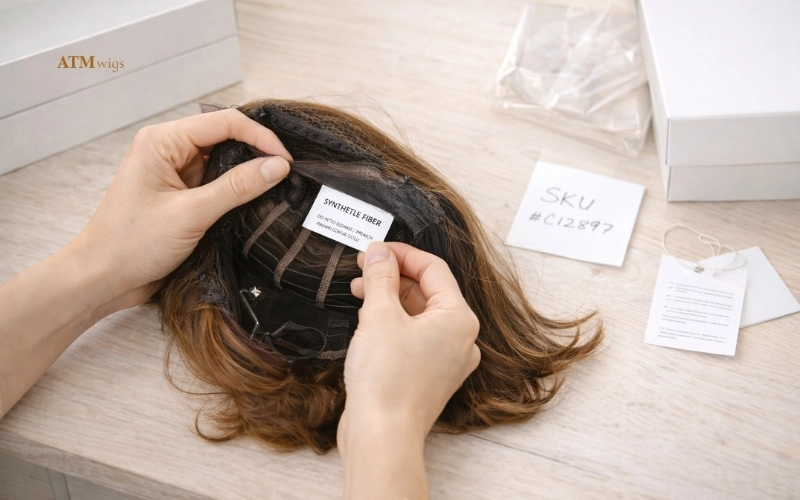
Step 1: Find the material tag
Turn the wig inside out and look for a small tag near the nape or side seam. Many wigs include a fiber label, sometimes with care notes.
Look for specific words that identify the fibre as either ‘synthetic fibre,’ ‘heat-friendly fibre,’ or ‘human hair.’ If the tag lists a heat range, then it is typically a synthetic fibre.
If the tag is missing, move to the SKU method below and the product page check.
Step 2: Check for a SKU, style name, or code
Using the tag or packaging, some wigs will have a style code or SKU number, and if you can find it, you can confirm which fibre it is made of within seconds.
Match the SKU to the original listing or ask the seller to verify it. Fiber type is a standard product spec for reputable brands and salons.
This method also helps avoid “guessing” based on shine alone.
Step 3: Look at wefts and construction (clue, not proof)
Wefting and cap features can hint at quality, but they do not confirm fiber type. Lace front, monofilament tops, and hand-tied construction exist in both synthetic and human hair.
Construction can tell you whether the wig was designed to look natural. A highly natural cap with realistic density can still be synthetic.
Treat the cap structure as context, and let the tag/SKU be the deciding factor whenever possible.
Synthetic vs human hair (the tell-tale differences)
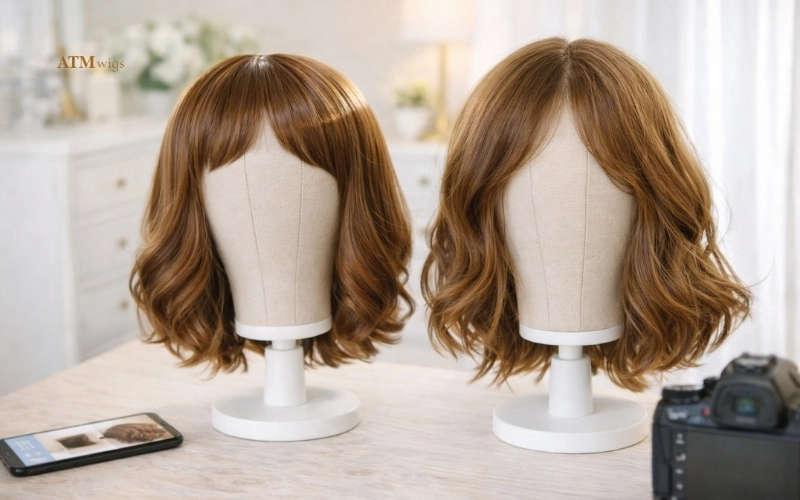
If you can compare two wigs side-by-side – or compare your wig to how real hair behaves – these differences become clearer.
Shine and “flash” effect in photos
Synthetic fiber is more likely to look shiny under indoor light or camera flash. Human hair usually photographs with a softer highlight pattern.
If your wig looks perfect in the mirror but overly reflective in photos, that’s often synthetic.
Movement and “style memory”
Synthetic wigs frequently hold their factory style with strong “memory.” Waves and curls often bounce back into the same pattern.
Human hair has more fluid movement and may lose styling over time, like natural hair. It can also be re-styled more naturally.
If your wig returns to the exact same curl shape after light moisture, it’s likely synthetic or heat-friendly synthetic.
Drying speed
Human hair typically takes longer to air dry, especially with density and length. Synthetic tends to dry faster and may feel “dry” sooner, even when the cap still holds moisture.
If your wig dries surprisingly fast, pair that clue with the mist test and tag check.
Friction frizz at the nape
Synthetic fiber is more prone to friction frizz at the nape and ends. Human hair can tangle, but it usually doesn’t develop the same “roughened” look as quickly if it’s in good condition.
If the nape looks puffy or fuzzy while the rest looks smooth, synthetic is a strong possibility.
Blends and heat-friendly synthetic
This is where many buyers get confused, especially when a wig feels soft.
Heat-friendly synthetic can feel very real
Heat-friendly synthetic is still a synthetic fiber, but it’s designed to tolerate limited heat and can feel smoother than standard synthetic.
Because it can look and feel more natural, the inside tag and product description become even more important.
If the listing mentions a temperature limit or “heat-friendly,” it’s almost always synthetic rather than human hair.
“Human hair blend” needs clarification
Some products are marketed as blends, but the term can mean different things depending on the seller. The only reliable approach is to confirm the material percentage.
If you see “blend,” check the full specs or ask for the exact fiber breakdown. If the seller can’t confirm, treat it cautiously.

If you still can’t tell
If your wig is high quality, visual clues alone may not be enough. Use verification steps that don’t risk damage.
Ask the seller or salon to confirm the material
You can confirm the wig materials with sellers/salon using any of the following: sending the wig style name or SKU, or photos of the wig tags inside of your wig.
Professional wig dealers can provide confirmation if your wig is synthetic, heat-friendly synthetic, or human hair. This will especially help you if you got the wig as a gift, purchased it secondhand, or it was recased by a business selling wigs.
Check the product page (material section)
Look for a clear “Material” line and any heat guidelines. Heat ratings and “fiber” language often confirm synthetic.
If the product page focuses on cap construction but never states fiber, that’s a good reason to request clarification.
Take photos in daylight
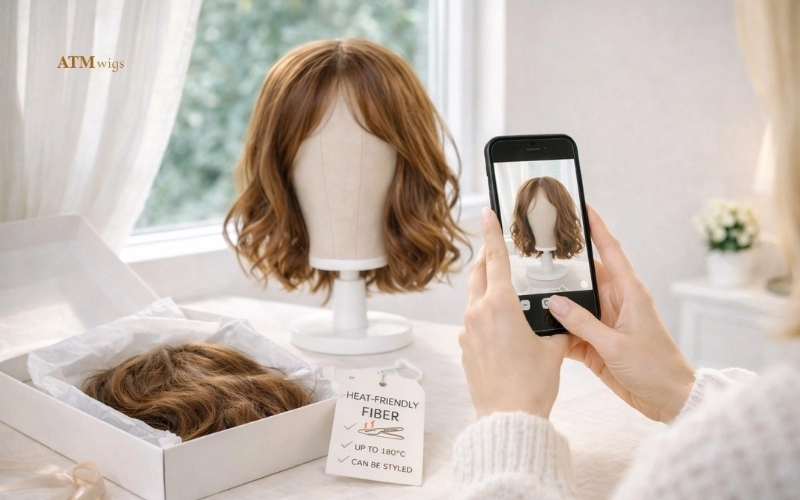
Daylight photos reveal shine and highlight patterns more accurately than indoor lighting. Take a quick photo near a window and compare how reflective it looks.
If the hair reflects in a very uniform way across the whole wig, synthetic hair becomes more likely.
FAQs about How do you know if a wig is synthetic?
Can synthetic wigs look like human hair?
Yes. Premium synthetic and heat-friendly synthetic wigs can look extremely realistic, especially with modern cap designs. That’s why checking tags or SKU is often the fastest confirmation.
Does synthetic always feel rough?
No. Many people expect synthetic to feel rough, but higher-quality fibers can feel soft and smooth. Focus on consistency, static, dry time, and inside tags instead of feel alone.
Can I use heat if it feels soft?
Not necessarily. Softness doesn’t mean it’s human hair. Only use heat if the wig is labeled heat-friendly and you follow the brand’s guidance.
Does a lace front mean it’s human hair?
No. Lace front is a cap feature, not a fiber type. Lace front wigs can be synthetic, heat-friendly synthetic, or human hair.
Why does my wig look shiny in photos but fine in the mirror?
Artificial fibers tend to be shinier in person than they appear in photos. The reason for this is due to indoor lighting and the use of a camera flash. Photos taken with natural light will be the best way to determine how shiny a wig is.
What’s the safest way to confirm wig material?
Check the inside tag, SKU, and product page material section. If those aren’t available, use no-tool checks like daylight shine and a light mist test.
Now you know how do you know if a wig is synthetic using safe checks like daylight shine, texture consistency, friction frizz, humidity behavior, and a quick inside-tag or SKU review. If you want wigs, toppers, or toupees that look natural and perform reliably, explore ATM Wigs’ catalog and services – and check our guides on how to make a synthetic wig look real and how to take care of a synthetic wig.

