

Toupee vs hair system can be confusing since the two terms often overlap. This guide will tell you what really makes the difference, where they are alike and what is most important when selecting one or the other.
Toupee vs hair system at a glance
| Feature | Toupee | Hair system |
|---|---|---|
| Traditional meaning | Partial hairpiece | Broader hair replacement term |
| Typical coverage | Front, top, or crown | Partial to larger scalp areas |
| Appearance | Can be highly natural | Can be highly natural |
| Base options | Lace, poly, mono, hybrid | Lace, poly, mono, hybrid |
| Attachment | Clips, tape, adhesive | Clips, tape, adhesive |
| Customization | Stock or customized | Stock, semi-custom, or custom |
| Maintenance | Depends on construction and wear | Depends on construction and wear |
| Best suited for | Often localized hair loss | Localized or broader hair loss |
The biggest difference is usually not the technology itself. It is how the terms are used and how much scalp coverage the product provides.
What is the actual difference between a toupee and a hair system?
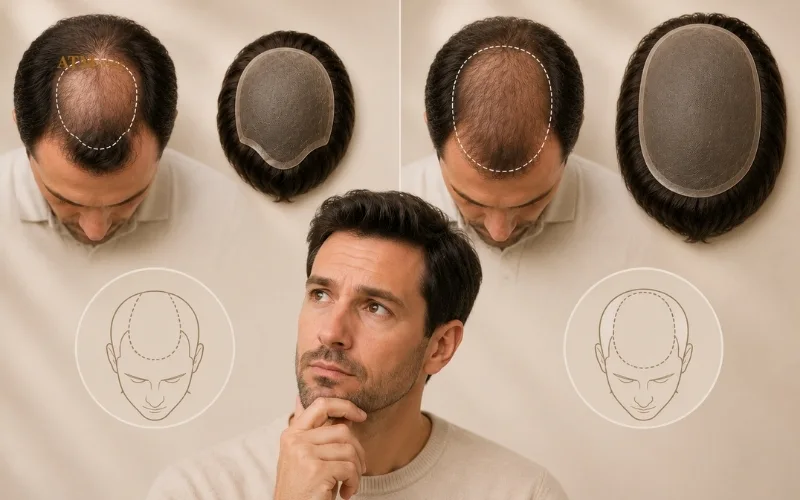
Traditionally, a toupee is a partial hairpiece intended to conceal a specific area of thinning or baldness, normally on the top, crown or front of the scalp.
A hair system is a broader term used for non-surgical hair replacement products. It may refer to a small partial piece, a top-of-head system, or a larger customized solution.
This means the categories are not completely separate.
A modern toupee may use the same hair, base materials, ventilation techniques, and attachment methods as a product marketed as a hair system.
In many cases, the difference is therefore more about terminology, coverage, and how the product is positioned than about a completely different construction.
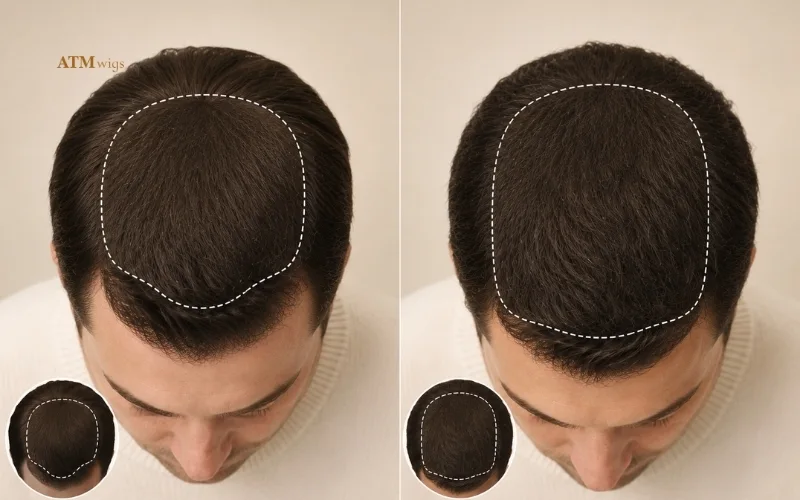
Is a toupee a type of hair system?
Yes, a toupee is generally considered a type of hair system.
The term “hair system” covers a wider range of non-surgical hair replacement solutions, while “toupee” traditionally describes a partial piece.
For example, a small system designed to cover thinning at the crown could reasonably be described as both a toupee and a partial hair system.
However, a larger system covering most of the top of the scalp may be described simply as a hair system rather than a toupee.
This is why product specifications matter more than the name alone.
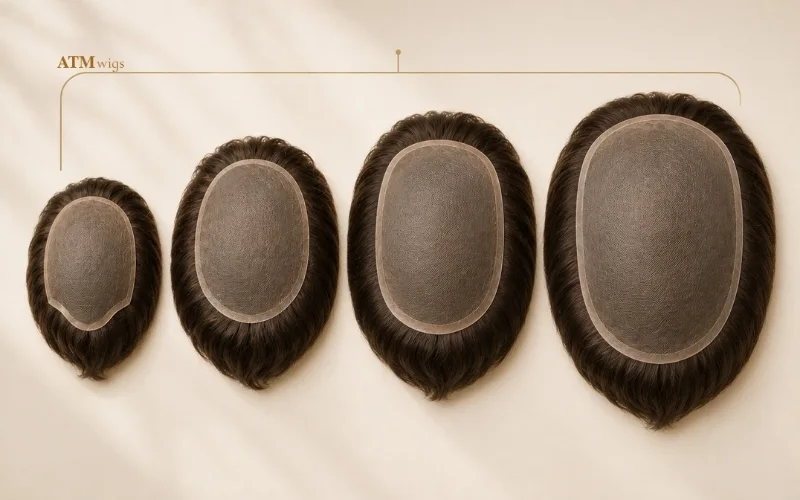
Toupee vs hair system: Key differences
Coverage area
Coverage is one of the clearest differences in the toupee vs hair system comparison.
A toupee usually covers a localized area such as the front, crown, or top of the scalp. It is often selected when natural hair remains around the sides and back.
The term hair system can describe both partial and larger coverage designs.
For someone with broader thinning across the top, a larger hair system may provide more suitable coverage than a small traditional toupee.
The exact size should always match the actual area of hair loss rather than the product label.
Construction
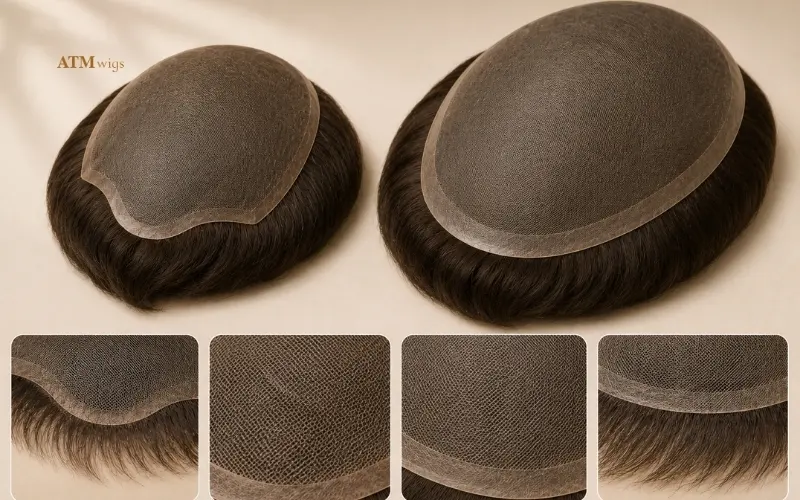
Toupees and hair systems are not separated by one specific base material.
Both can use lace, poly, monofilament, or hybrid constructions.
This is important because some people assume a toupee always uses an older or heavier base while a hair system always uses a modern, thin base. That is not necessarily true.
A modern toupee can use very lightweight materials, while a hair system can also use a more structured base depending on its intended purpose.
When comparing the two, look at the actual base specification instead of assuming one category is more advanced.
Natural appearance
Neither option automatically looks more natural.
A high-quality toupee can look just as discreet as a hair system if the color, density, hairline, texture, and fit match the wearer correctly.
Likewise, a poorly matched hair system can still appear noticeable.
Natural appearance depends on how well the piece integrates with existing hair and scalp rather than whether it is labeled “toupee” or “hair system.”
For buyers focused on realism, the hairline design, density, color blend, and overall fit are more important than terminology.
Attachment
Both toupees and hair systems can use clips, tape, liquid adhesive, or a combination of attachment methods.
A toupee is not always removable, and a hair system is not always bonded for long periods.
Some people prefer daily removal, while others choose extended wear.
The appropriate attachment method depends on lifestyle, scalp condition, base construction, and how frequently the wearer wants to remove the piece.
The key difference is therefore not “toupee attachment versus hair system attachment,” but how each individual product is designed to be worn.
Comfort
Comfort depends more on the specific construction than on the category name.
A lightweight partial toupee may feel very comfortable because it covers a smaller area.
A larger hair system may provide broader coverage but may also involve more scalp contact.
At the same time, base thickness, ventilation, climate, attachment, and individual sensitivity all influence comfort.
For this reason, it is difficult to say that either a toupee or hair system is universally more comfortable.
Customization
Both categories can offer considerable customization.
A toupee may be selected or customized by size, color, density, texture, gray percentage, hair direction, and hairline style.
Hair systems can offer the same options, especially in semi-custom and custom designs.
The main difference is that the broader “hair system” category may include a wider variety of sizes and coverage configurations.
If a wearer has an unusual hair loss pattern, customization may matter more than whether the product is marketed as a toupee.
Styling options
Styling flexibility is also similar between modern toupees and hair systems.
Both can support different lengths, textures, parts, and hairstyles depending on the hair type and ventilation pattern.
A person who wants an exposed front hairline may need a different front design from someone who prefers to wear the hair forward.
Human hair can also offer more flexibility for heat styling and restyling compared with many synthetic options.
Again, styling performance depends on the actual product specifications rather than the terminology.
Maintenance
There is no fixed maintenance difference between a toupee and a hair system.
Maintenance depends on how the piece is attached, how often it is worn, and the type of base and hair used.
A removable toupee may follow a different routine from a bonded system, but a removable hair system could require a similar routine.
Instead of asking which category is easier to maintain, it is more useful to compare the exact wear method and construction of the two products being considered.
Lifespan
Neither a toupee nor a hair system has a guaranteed longer lifespan simply because of its name.
Durability depends on factors such as base strength, hair quality, frequency of wear, handling, styling, and cleaning.
A very invisible system might need more careful handling and replacement earlier.
A stronger construction may last longer but feel more substantial.
When comparing lifespan, look at the actual design and intended use rather than assuming hair systems always last longer than toupees.
Cost
There is also no simple rule that one category costs more.
The cost of a toupee or hair system can vary greatly, depending on the type of hair, the base construction, the density, the length, the level of customization, and whether it includes professional fitting or services.
A basic stock toupee can retail for less than a fully customized hair system.
However, a premium human hair toupee with advanced customization may cost more than a standard stock hair system.
Price should therefore be compared product by product.
Toupee or hair system: Which should you choose?
The better option depends mainly on the wearer’s hair loss pattern and expectations.
Choose based on coverage
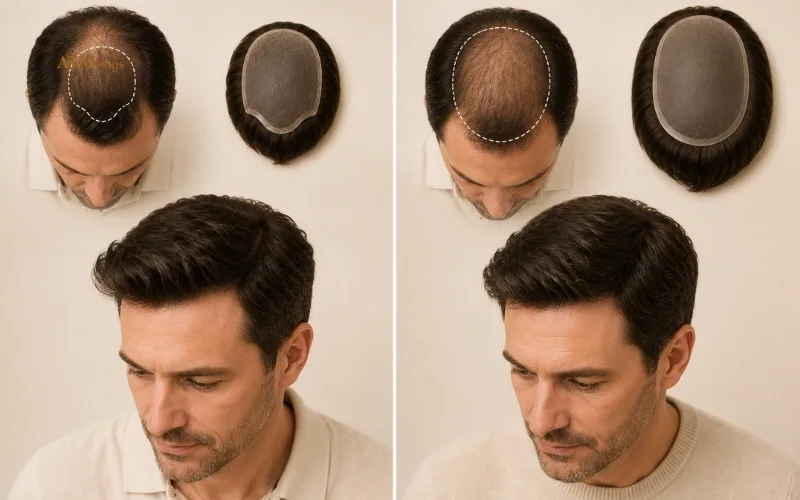
If hair loss is limited to one small area, a partial toupee may provide enough coverage without covering more of the scalp than necessary.
If the thinning is over a larger part of the top of the head then you might want to consider a wider hair system.
Choose based on your existing hair
Partial toupees usually require blending with natural hair around the area covered.
Therefore, matching color, texture, density and length is important.
For more extensive hair loss, a larger system may reduce the amount of blending needed.
Choose based on your preferred wear style
Think about whether you want to remove the piece regularly or wear it for longer periods.
Both toupees and hair systems can support different attachment styles, so the product should be chosen according to the desired routine rather than the name.
Choose based on your appearance goals
If the priority is an exposed hairline, low density, or a specific hairstyle, focus on the base design and ventilation.
If durability or easier handling matters more, a slightly stronger construction may be preferable.
The right choice is the product whose specifications match the wearer’s needs.
Does the term “toupee” or “hair system” really matter?
Not as much as many buyers assume.
“Hair system” has become a common modern term, while “toupee” is often associated with partial men’s hairpieces.
However, the two can overlap significantly in real products.
Two pieces marketed under different names may use the same type of hair, the same base, and the same attachment method.
At the same time, two products both called hair systems may have completely different coverage, density, durability, and appearance.
Before choosing, compare the actual specifications:
- Coverage size
- Base construction
- Hair type
- Density
- Color and texture
- Hairline design
- Attachment method
- Customization
- Intended wear style
These details provide a much clearer comparison than the product name alone.

Toupee vs hair system: Which is better?
Neither is automatically better.
A toupee may be ideal for localized hair loss, as it covers only the area needed and blends with existing hair.
If the thinning is more widespread over the scalp or if greater customization is desired, a larger hair system may be more appropriate.
The best option is therefore the one that matches the wearer’s coverage needs, preferred appearance, lifestyle, and maintenance expectations.
FAQs about toupee vs hair system
Is a toupee the same as a hair system?
A toupee can be a type of hair system, but the two terms aren’t always interchangeable. Partial coverage is called a toupee and the term hair system is used more generally for non-surgical hair replacement.
Is a hair system more modern than a toupee?
Not necessarily. Modern toupees can use the same lightweight bases, human hair, ventilation methods, and attachment options as products marketed as hair systems.
Which looks more natural, a toupee or a hair system?
Neither is automatically more natural. Realism depends on hairline design, density, color matching, texture, base visibility, and fit.
Which lasts longer, a toupee or a hair system?
Lifespan depends on construction, hair quality, wear frequency, and care rather than the product name. A stronger base may last longer than a delicate ultra-thin design in either category.
Is a toupee better for partial hair loss?
It can be. Toupees are often made for localized thinning at the front, top or crown, making them a practical option when only part of the scalp needs to be covered.
Understanding toupee vs hair system is mainly about comparing coverage, construction, fit, and wear preferences rather than labels. Explore ATM Wigs’ toupee and hair system catalog to find options suited to different hair replacement needs.

