


Comparing stock vs custom toupees involves more than just price and delivery time. This guide will break down the differences in fit, appearance, durability, maintenance and long-term value of both options.
Stock vs custom toupees at a glance
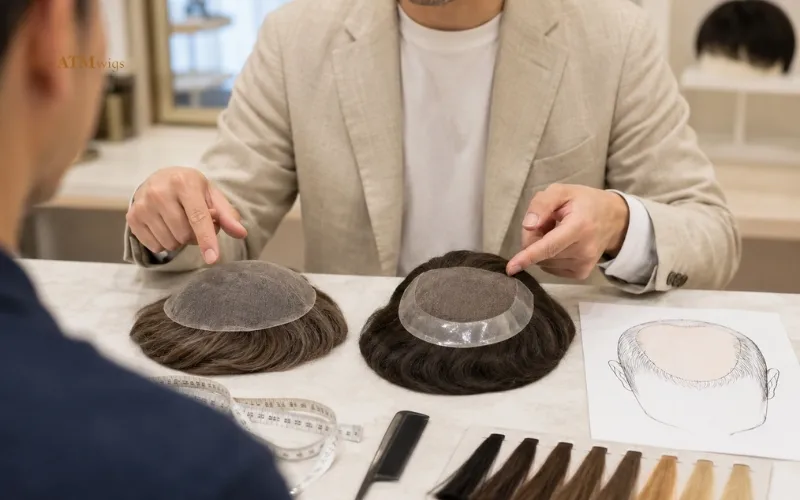
A stock toupee is made in advance with popular sizes, colors, densities and base constructions. Once your order is received, your custom made toupee is fabricated to your individual measurements and specifications.
Custom does not automatically mean more natural, while stock does not necessarily mean lower quality. The right choice depends on how closely a standard system matches the wearer’s needs.
| Comparison factor | Stock toupee | Custom toupee |
|---|---|---|
| Base size | Standard and usually trimmable | Made to individual measurements |
| Hair color | Selected from available shades | Can be specially matched or blended |
| Density | Predetermined options | Individually specified |
| Hairline contour | Standard shapes | Personalized shape |
| Base construction | Existing designs | Selected materials can be combined |
| Availability | Usually faster | Requires production time |
| Initial cost | Generally lower | Generally higher |
| Ordering risk | Easier to inspect before alteration | Depends heavily on accurate specifications |
| Reordering | Simple when the model remains available | Easier when specifications are recorded |
| Best suited to | Common needs and faster replacements | Complex or highly specific needs |
What is the main difference between stock and custom toupees?
The main difference is when and how the hair system is produced.
The stock wigs are made prior to an order. Buyers should select nearest size, color, density, texture and base construction available and make any required modifications.
Custom toupees are produced according to submitted measurements, a scalp template, or detailed specifications. The base shape, color, density, curl, hairline, and hair direction can be selected before production.
The decision is not simply between a basic and a premium product. It is about whether an existing system can meet the wearer’s requirements without excessive alteration.
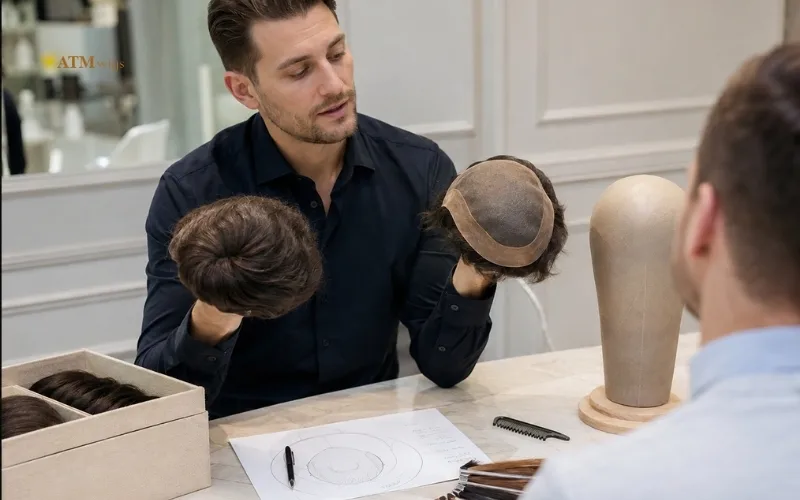
Fit and base size
Fit is one of the most important factors when comparing stock vs custom toupees.
Stock systems are usually manufactured in standard base dimensions. A base that is larger than the wearer’s hair-loss area can often be trimmed to create a closer fit.
However, trimming has limits. Removing too much material may affect the front contour, crown position, polyurethane perimeter, attachment zones, or hair ventilation pattern.
A stock base also cannot be enlarged. When the wearer needs more coverage than the original dimensions provide, a larger stock size or custom system may be required.
Custom toupees are particularly useful for irregular or asymmetrical hair-loss areas. A scalp template can follow the required shape more accurately than standard length and width measurements.
However, a custom fit is only as accurate as the information submitted. Incorrect measurements or an inaccurate template can still produce a base that feels tight, loose, or improperly positioned.

Hairline shape and front realism
A natural-looking front is one of the main reasons wearers consider custom hair systems.
Stock toupees generally use common front contours, such as rounded, standard, or slightly receded hairlines. These shapes suit many wearers when they are positioned and styled correctly.
Custom toupees allow the contour to be adapted to the wearer’s facial structure, age, existing hairline, and level of recession.
This may be useful for a widow’s peak, mature hairline, uneven temple recession, or another shape that is unavailable in a standard stock system.
Customization alone does not guarantee realism. Base thickness, front density, knotting, ventilation, placement, attachment, and styling also affect the finished hairline.
A properly fitted stock lace toupee may appear more realistic than a poorly specified custom system with excessive density or an unsuitable front contour.

Hair color and grey matching
Stock toupees usually come in standard shades and selected grey percentages. These options may work well for wearers with a common and relatively even biological hair color.
Matching becomes more difficult when the wearer has multiple tones, highlights, faded ends, different temple shades, or uneven grey distribution.
Custom toupee gives you more control on where the color is placed. Grey hair can be kept to the temples, blended through the top or minimised at the front.
But custom matching is accurate only with reliable references. Please note colors on screen depend on lighting conditions and screen settings and that digital photographs can be misleading.
A physical color ring or hair samples taken from the sides, temples, and back usually provide a more accurate reference.
Stock systems may also be professionally colored or adjusted. However, additional chemical processing can affect the hair and may change the product’s return or warranty eligibility.

Density and age-appropriate appearance
Density is one of the most common reasons a stock toupee may require alteration.
Stock systems are produced in predetermined density ranges. Although multiple density options may be available, they may not perfectly match every wearer’s remaining hair.
A system that is too dense can look unnatural, particularly around the front, temples, or crown. It may also be difficult to blend with fine or thinning biological hair.
Custom toupees allow density to be specified more precisely. A wearer may request a graduated front, lighter temple areas, or different density levels across the base.
This can be particularly valuable for older wearers or people with naturally fine hair.
Stock density can often be reduced by an experienced professional. However, significant thinning adds cost and may create uneven results when it is not performed carefully.
Base construction and comfort
Both stock and custom toupees may use lace, thin skin, monofilament, polyurethane, or hybrid base constructions.
A well-developed stock collection can already meet many comfort and attachment needs. For example, a wearer may select lace for breathability or thin skin for easier adhesive cleanup.
Custom production becomes more valuable when separate areas of the base require different functions.
A custom design may combine fine lace at the front, a breathable center, and reinforced polyurethane sections for tape or liquid adhesive.
The wearer may also need a specific base design because of scalp sensitivity, scar tissue, an active lifestyle, or a preferred attachment method.
Stock or custom production does not determine comfort by itself. Comfort depends more directly on the base material, sizing, attachment method, climate, and wearing routine.
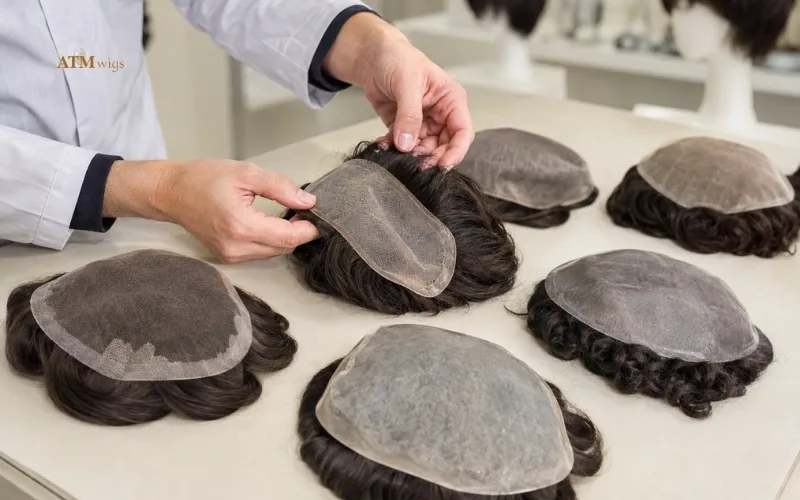
Hair texture, curl, and direction
Stock toupees are available in popular textures such as straight, body wave and light curl.
Once the hair is professionally cut and blended, these options can be used to create a variety of short and medium length hairstyles.
Custom systems provide more control over curl diameter, wave pattern, parting position, crown placement, and ventilation direction.
This can be important when the toupee must blend with highly textured biological hair or support a specific style, such as a defined side part or brushed-back front.
Hair direction is particularly difficult to change after production. Styling products can temporarily redirect the hair but cannot fully replace the correct ventilation pattern.
Custom production may therefore yield better results where hair direction is a critical requirement rather than a flexible preference.
Lead time and availability
Stock toupees are usually the faster choice as they are already manufactured.
Perfect for emergency replacements, first time trials, travel backups, or when the wearer can’t wait for custom production.
Custom toupees require specification review, production, quality control, and delivery. Special color blending or unusual curls may add to lead time, as may complex base designs.
A workable solution is to keep a proper stock system as a fallback until the custom unit arrives.
This reduces the risk of not having a wearable system during maintenance, repair or unexpected replacement.

Cost and long-term value
Stock toupees are usually cheaper to start with because they are made in larger numbers and with standard specifications.
Custom toupees are usually more expensive because they have to be individually planned, produced and quality controlled.
However, the purchase price does not represent the full cost.
A stock toupee may require base trimming, density reduction, coloring, grey adjustment, professional cutting, or styling before it is ready to wear.
When these alterations are extensive, the total cost may approach or exceed the price of a properly specified custom system.
Custom toupees may provide better long-term value when the same detailed specifications can be reordered consistently.
But, new wearers could pay a premium for a custom system before they know what density, base construction or attachment method they prefer.
The best value is the one that involves fewer compromises and avoids unnecessary modifications.
Durability and lifespan
Custom toupees are not always more durable than stock toupees.
Lifespan depends mostly on the base material, quality of hair, method of ventilation, maintenance routine, attachment process and frequency of wearing.
An ultra-thin skin custom system may offer great realism but a shorter life span than a stronger stock lace or monofilament system.
Similarly, a custom system with delicate front lace still requires careful cleaning, removal, and reattachment.
Customization can improve durability when the design is specifically adapted to the wearer’s routine.
For example, reinforced attachment areas may support extended wear, while a stronger base may be better for frequent removal and reattachment.
Maintenance requirements
Maintenance depends mainly on the base construction, attachment method, hair type, density, length, and wearing schedule.
A custom toupee is not necessarily easier to clean or style than a stock system.
Lace bases may require careful adhesive removal. Thin skin systems may be easier to clean but can be more vulnerable to stretching or tearing.
How long it takes to wash, condition, detangle and style also depends on hair length, density and curl.
Buyers should consider the construction of the toupee they choose in relation to their maintenance habits rather than assuming a custom system is less maintenance when comparing stock vs custom toupees.
Reordering and consistency
Usually stock toupees are easy to re-order if the same model, color and density is still available.
However, minor differences can occur between production batches. Human hair is a natural material so hair color, curl and density may vary a little.
Custom made toupees are better specified when the supplier keeps the order details, scalp template, measurements and color references.
But, even in handmade production, there may be slight differences between individual units.
For more consistent reordering, you may find it helpful to note the base design, measurements, density, color blend, grey placement, curl, hair direction, and finished hairstyle.
A physical reference of a previously approved system can also improve consistency.
Ordering and return risks
Stock systems generally carry less ordering risk, as the buyer can see the specifications available before choosing a unit.
Return conditions for unused stock toupees may be more flexible depending on the supplier.
Once the base is trimmed, the hair is cut, the color is changed, or adhesive is applied, the toupee may no longer qualify for a return or exchange.
Custom orders involve greater specification risk. Common mistakes include incorrect base measurements, excessive density, unsuitable curl, the wrong front contour, or inaccurate grey placement.
Because the unit is produced for a specific order, custom toupees often have more restricted return and exchange conditions.
Every specification should therefore be reviewed carefully before production begins.
Who should choose a stock toupee?
A stock toupee is generally suitable when:
- The hair-loss area fits within a standard base
- A standard shade closely matches the wearer’s hair
- The required density and texture are available
- The wearer needs a system quickly
- The unit will be used as a backup
- The wearer is testing base and attachment preferences
- Only minor trimming and styling are required
Stock systems are often practical for first-time wearers because they provide a lower-risk way to understand daily comfort, attachment, and maintenance.
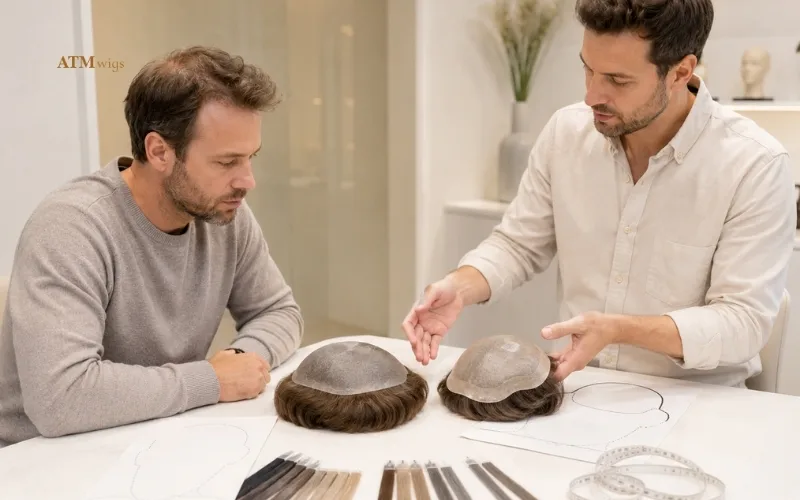
Who should choose a custom toupee?
A custom toupee may be more suitable when:
- The coverage area is irregular or asymmetrical
- Standard front contours do not look appropriate
- The wearer needs a specific color or grey blend
- Stock density repeatedly requires major thinning
- A specialized curl or hair direction is necessary
- Different base materials are required in separate zones
- Previous stock systems needed extensive alteration
- The wearer already understands their preferred specifications
Custom production is most valuable when it solves a clear fit, appearance, or construction problem that stock systems cannot address effectively.
FAQs about stock vs custom toupees
Are custom toupees always more natural than stock toupees?
No. Custom toupees allow you more control over fit and appearance, but a stock toupee that fits well can look just as natural after being cut, blended and attached by a professional.
Can a stock toupee be trimmed into any shape?
Not always. The base can often be reduced, but extensive trimming may affect the front contour, crown position, ventilation pattern, or reinforced attachment areas.
Do custom toupees last longer?
Not necessarily. The stock or custom system has less to do with lifespan than the base material, quality of hair, maintenance, attachment method and wearing frequency.
Is a stock toupee better for first-time wearers?
It often is when standard specifications fit the wearer. A stock system allows new users to test density, base materials, and attachment methods before ordering a custom unit.
Can the same custom toupee be reordered?
Yes, as long as the supplier retains the measurements, template, color, density and construction details. Because human hair systems are hand-made, slight variations may still occur.
When considering stock vs custom toupees, choose the one that provides the right fit with the fewest compromises. Check out ATM Wigs’ services and human hair catalog to find a suitable solution.

