

How much do hand tied wigs cost? Premium human hair hand tied wigs are frequently in the four figures, and can cost thousands of dollars. The final price will depend on the amount of hand tied cap, the quality and amount of human hair used and the complexity of the construction.
How much do hand tied wigs cost?
As a broad retail benchmark, premium hand tied human hair wigs may cost around $1,000 to $4,000 or more, depending on their specifications.
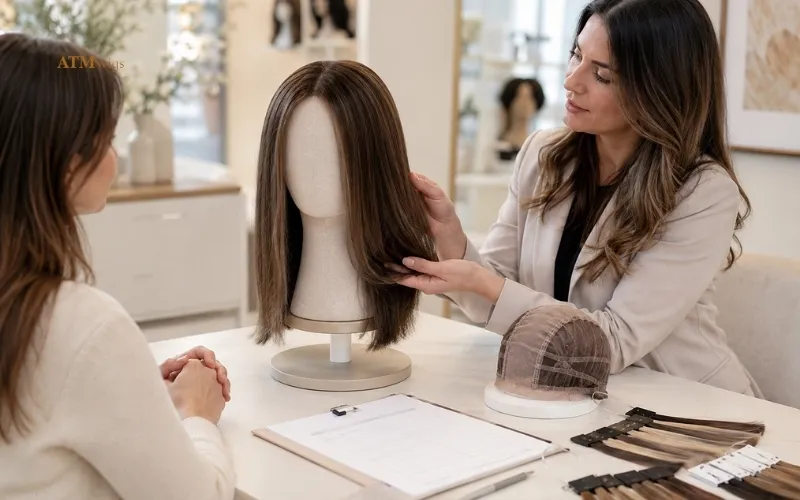
The range is wide because “hand tied” does not describe one fixed type of wig. One wig may have only a hand-tied top or front, while another may be manually ventilated across almost the entire cap.
Hair quality, length, density, cap materials, color work, and customization can also change the final price significantly.
For this reason, two wigs that appear similar at first glance may have very different production costs.
| Price factor | How it affects cost |
|---|---|
| Amount of hand tying | More manual ventilation requires more labor |
| Human hair quality | Better and more consistent hair costs more to source |
| Hair length | Longer usable strands are less abundant |
| Density | More hair and more ventilation work are required |
| Cap construction | Lace, monofilament, and combined bases add complexity |
| Color | Dimensional shades can require more processing |
| Customization | Individual specifications require additional work |
Understanding these factors makes the price difference between hand tied wigs much easier to explain.
Why do hand tied wig prices vary?
The biggest reason is that not every hand tied wig is constructed in the same way.
The term may refer to a wig with a hand-tied top, a lace front with hand ventilation, several hand-tied sections, or a cap that is almost entirely ventilated by hand.
These constructions require very different amounts of labor.
The hair itself can also vary considerably. A short wig using standard human hair does not have the same raw material requirements as a long wig made with carefully selected, consistent human hair.
Price is therefore determined by a combination of construction, materials, hair quantity, and production complexity, rather than by the “hand tied” label alone.

How hand-tied construction affects cost
Manual ventilation is one of the main reasons hand tied wigs can cost more than simpler constructions.
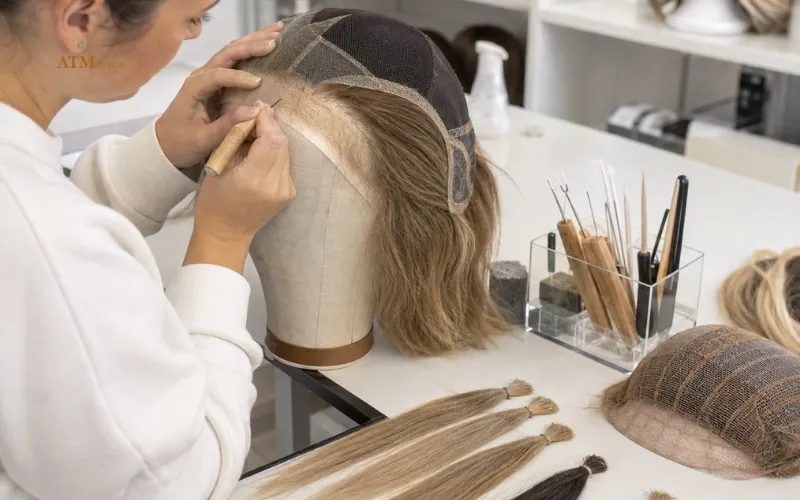
During this process, individual hairs or small groups of hairs are attached to the base by hand. The person ventilating the wig must control hair direction, spacing, knot placement, and density across the area being worked on.
The larger that area becomes, the more time and skilled labor are required.
Partially hand tied wigs
A partially hand tied wig may use manual ventilation only in selected areas, such as the lace front, crown, monofilament top, or parting area.
The sides and back may use machine-sewn wefts.
Because less of the cap needs to be ventilated by hand, production requires fewer manual working hours than a fully hand tied design.
This is one reason partially hand tied wigs generally cost less than otherwise comparable 100% hand tied wigs.
100% hand tied wigs
With a fully hand tied wig, most or all of the cap is manually ventilated.
That means substantially more individual hair placement is required across the entire base.
The maker must also maintain consistent density and direction from one section to another, which adds production time.
As a result, the amount of the cap that is actually hand tied is one of the clearest factors affecting the final hand tied wig cost.
How human hair quality affects cost
Human hair is another major component of the price.
Premium wig production requires enough hair that meets specific standards for length, condition, texture, and consistency.
The more selective the sourcing process becomes, the less of the original supply may be suitable for use.
That lower usable yield increases raw material cost.

Does Remy human hair affect the price?
Remy human hair is commonly valued because the hair cuticles are kept aligned in the same direction.
Keeping this alignment requires more controlled sourcing and handling, and that can add to the price.
However, the word “Remy” alone does not determine cost or quality.
Processing level, consistency, condition, length, and sourcing standards also influence how much the hair costs before it is made into a wig.
For hand-tied wigs, this matters because the final price reflects both the cap labor and the human hair being ventilated into it.

How hair length affects cost
Hair length can change the price substantially, even when the cap construction stays the same.
A longer wig does not simply contain a few extra inches of material.
Manufacturers need enough naturally long strands that remain suitable after sorting and processing.
Long, healthy human hair is less abundant than shorter hair, particularly when consistent texture and condition are required.
For example, a 20-inch hand tied wig may use the same basic cap construction as a 10-inch version, but the cost of the raw hair can be significantly higher.
The longer the required usable length, the more important hair sourcing becomes in the final price.

How density affects cost
Density refers to the amount of hair used across the wig.
Higher density generally increases cost because more human hair is required.
In a hand tied construction, it can also increase labor cost because additional hair must be ventilated into the base.
Density therefore affects price in two ways:
more hair material + more hand ventilation.
However, the relationship is not simply “higher density equals higher quality.”
Different styles require different density levels.
From a pricing perspective, the key point is that a denser wig normally requires more raw material and more production work than a comparable wig with lighter density.

How cap construction affects cost
Hand tying does not work in isolation. The other materials and structures used in the cap also contribute to the final price.
Premium constructions may combine hand-tied areas with fine lace, monofilament, stretch sections, polyurethane, reinforcement, or other specialized materials.
Each additional element can increase material use and the number of production steps required.
Lace front
A lace front requires hair to be carefully ventilated into a fine lace base around the front hairline.
Because this area is highly visible, spacing and hair direction need to be controlled carefully.
Finer lace can also require more delicate handling during production.
A hand tied wig that includes a detailed lace front may therefore cost more than a simpler cap using less complex front construction.
Monofilament
Monofilament is commonly used at the top, crown, or parting area of a wig.
Adding a monofilament section means combining another base material with the rest of the cap and ventilating hair into that area.
A wig that includes a lace front, monofilament top, and additional hand-tied sections requires more construction stages than a basic wefted cap.
That extra complexity contributes to the production cost.

How color affects hand tied wig cost
Color processing can also play a role in the cost of a human hair hand tied wig.
Simple solid shades usually require less processing steps than complex color combinations
Rooted shades, highlights, lowlights, gray blends, balayage effects and dimensional blondes can take multiple stages of lifting, toning, coloring and blending.
It is even more difficult when the shade you want to achieve means you have to lighten the hair a lot but at the same time the hair needs to be still usable for the wig making.
Therefore, the price difference is not necessarily because one color is more expensive than another.
Production time, material use and cost can be added by the complexity of the color process.

How customization affects cost
Standard off-the-rack wigs are made from specifications that can be repeated.
Custom wigs require more work for each individual piece.
Customizations may include:
- specific cap sizes
- customized hair density
- a certain length of hair
- custom texture
- specific hairline
- color match
- extra cap features
Any requirement may impact on time for sourcing, construction, finishing or manufacturing.
The more specifications that differ from a standard design, the more individual work may be required.
For this reason, custom hand tied human hair wigs generally cost more than comparable ready-to-wear options.
FAQs about hand tied wig cost
How much does a 100% hand tied human hair wig cost?
A premium 100% hand tied human hair wig commonly falls within the four-figure price range and may reach several thousand dollars.
The final price will depend on the quality, length, density of the human hair, materials used for the cap, color processing and customization.
Why are hand tied human hair wigs more expensive?
The machine-sewn weft construction requires far less labor than manual ventilation.
If this handwork is combined with premium human hair, special cap materials, longer lengths or more complex coloring, the cost of production increases even more.
Does “hand tied” always mean 100% hand tied?
No. Some wigs are hand tied only in selected areas such as the top, crown, parting area, or lace front.
A fully hand tied wig requires manual ventilation across most or all of the cap, which generally involves more labor and therefore a higher production cost.
Does longer human hair increase the price?
Typically, yes.
Long, healthy strands are more rare and harder to find with any consistency of quality. The longer the required length, the less likely it is that the strands from the original hair source will meet the required specifications.
This increases the cost of the raw hair required to make the wig.
Does higher density make a hand tied wig more expensive?
Generally, yes.
Higher density requires more human hair. In a hand tied wig, the additional hair also requires more manual ventilation work.
Both factors can increase the final cost.
Do lace front and monofilament features increase the cost?
They can.
Fine lace and monofilament add materials and additional construction stages to the cap. When these areas also require precise hand ventilation, they can increase the amount of skilled production work involved.
How much do hand tied wigs cost depends mainly on the amount of hand ventilation, human hair quality, length, density, cap construction, color, and customization. Explore ATM Wigs’ human hair wig catalog and services to compare different constructions and specifications for your needs.

