

Hair toppers are made to give you localized coverage and volume without covering your whole head. In this guide, you will learn how hair toppers work, the main types of toppers, how to select the right option, and what makes a natural-looking result.
Look at the different styles, lengths, colors and base constructions of toppers to find one that meets your coverage needs and compliments your current hairstyle.
What are hair toppers?
Hair toppers are partial hairpieces that are meant to cover a particular area of thinning or add extra volume to the top of the head.
A topper is not a full wig and leaves much of the natural hair visible. The topper hair blends with the wearers own hair for a fuller and more natural balanced look.
Hair toppers are usually made for the part line, crown or upper sides. They come in different base sizes, densities, lengths, textures and hair types .
How does a hair topper work?
A hair topper is a base with hair attached to it. The base is positioned over the area to be covered and can be secured with clips or other suitable means.
The topper hair is blended in with the natural hair around it once in place. Correct placement, base size, density, color and texture will all affect how natural the final result looks.
Who can wear hair toppers?
Hair toppers can work well for those with localized thinning, reduced crown density, a widening part, or just areas where more volume is desired.
They can also be used by people who just want more volume but don’t want to wear a full wig.
The best choice depends on how much coverage is needed and the condition of the natural hair that can be blended and attached.
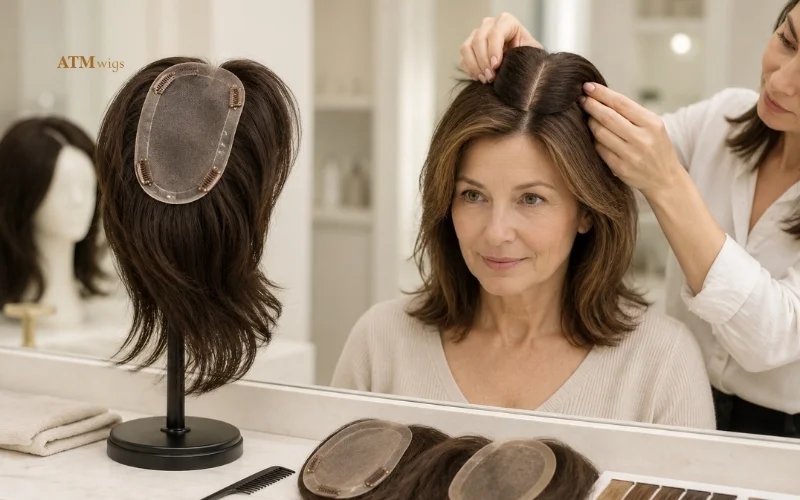
Types of hair toppers
Hair toppers come in a wide range of hair qualities and base constructions. Those differences impact the look, how much you can style it, comfort and how well the topper mixes in with your natural hair.
It is much easier to choose the right topper when you know the main options.
Human hair toppers
Human hair toppers are popular because they move and style like natural hair. They can normally be cut, curled, straightened and restyled to match the wearer’s existing hair.
High-quality human hair can also make it easier to blend the topper seamlessly with natural hair.
However, the final appearance still depends on the choice of right density, color, texture, length and base design.
Synthetic hair toppers
Synthetic toppers are made from man-made fibers engineered to maintain a particular style.
They generally require less day-to-day styling and can maintain their original shape after washing.
Their styling flexibility can be more limited than human hair, especially when heat is involved. Always check whether the specific fiber is heat-resistant before using styling tools.
Lace front toppers
A lace front topper uses fine lace around the front edge to create a softer transition near the hairline.
This construction can be useful when thinning extends toward the forehead or when the front edge of the topper may be visible.
Because lace is delicate, it should be handled gently during application, washing, and styling.
Monofilament toppers
Monofilament toppers use a fine mesh construction that allows individual hairs to appear as though they are growing from the scalp.
This construction can create realistic-looking parting and allow greater flexibility in directing the hair.
Monofilament bases are often considered when scalp appearance and parting versatility are important priorities.
Silk top toppers
Silk top toppers use an additional layer that helps conceal the knots beneath the surface.
This makes for a smoother, scalp-like look at the parting and can work very well when a natural looking scalp coverage is important.
PU or skin base toppers
PU, also known as polyurethane or skin material, creates a smooth base surface.
It may be used across the full base or combined with lace, monofilament, or other materials.
The best base construction will depend on coverage needs, preferred type of attachment, comfort, flexibility, and desired finished look.
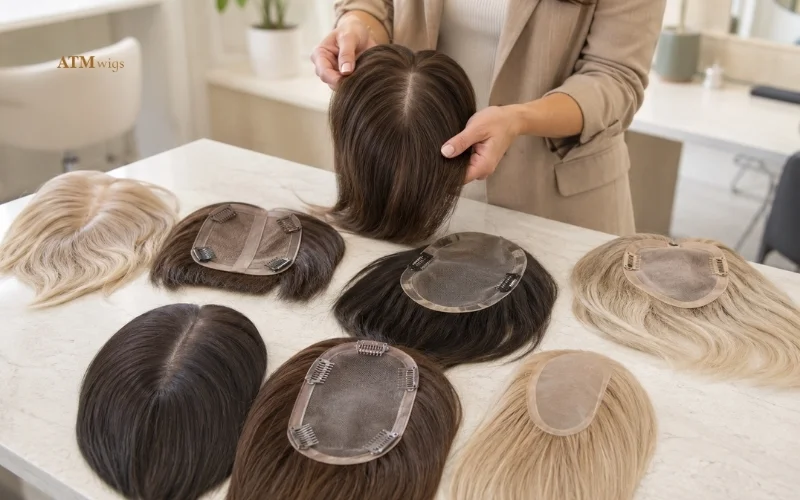
How to choose the right hair topper
Choosing a hair topper is not only about picking a desired hairstyle.
The base should cover the necessary area and the hair itself should blend in with the wearer’s length, density, color, and texture.
Start with the area you want to cover
First, identify exactly where you need more coverage.
Some people just need more density around the part while others need more coverage across the crown or top of the head.
The bottom should be long enough to go beyond the thinning area to provide stable coverage without being too big.
Choose the right base size
Smaller topper bases can be used for localized thinning or for adding subtle volume.
Larger bases provide broader coverage when thinning extends across the crown or upper scalp.
For clip-in hair toppers, there should also be enough healthy natural hair around the base to support secure attachment.
Consider your natural hair density
A common mistake is choosing the highest possible density.
If natural hair is fine or relatively light in volume, an extremely dense topper may be difficult to blend.
The goal should be balanced coverage and realistic fullness rather than maximum volume.
Match the hair length
The topper should work with the wearer’s existing haircut.
It does not always need to match the exact length because human hair toppers can often be professionally cut and blended after fitting.
Choosing a reasonably similar starting length, however, usually makes customization easier.
Match the color carefully
Natural hair color is rarely just one flat shade.
When selecting a topper, consider the roots, overall base color, highlights, lowlights, and tonal variation.
Rooted or blended colors can sometimes integrate more naturally with multidimensional biological hair than a single solid shade.
Match the texture
Texture should also complement the natural hair.
Straight toppers generally blend most easily with straight hair, while wavy or curly toppers should follow a similar movement pattern to the wearer’s existing texture.
Human hair toppers provide more flexibility because they can usually be restyled when needed.
Consider the hairline and parting
Coverage needs near the hairline are different from those at the crown.
If thinning extends close to the forehead, a lace front or another fine front construction may help create a softer transition.
For crown or part-line coverage, base size and scalp-like parting may be more important.
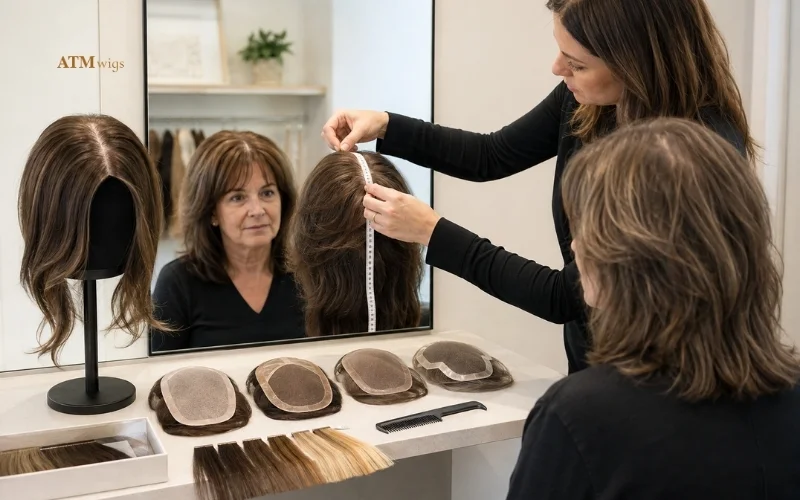
Hair toppers for different levels of thinning
The amount and location of thinning play an important role in topper selection.
There is no single base size or density that works equally well for every wearer.
Early thinning around the part
For mild thinning or a widening part, a smaller topper may provide enough coverage while adding subtle volume.
A lightweight base and moderate density can often create a more natural result than using a much larger piece.
Thinning across the crown
Crown thinning generally requires a wider base to keep the affected area covered during normal movement and styling.
When choosing a crown hair topper, parting design, density distribution and clip placement should also be considered.
More extensive thinning
If your thinning is extensive over much of the top of the head, a larger topper can provide more coverage, while still allowing natural hair to be seen around the perimeter.
If there’s not a lot of natural hair to blend the hair to, then a full wig may be the more practical choice.
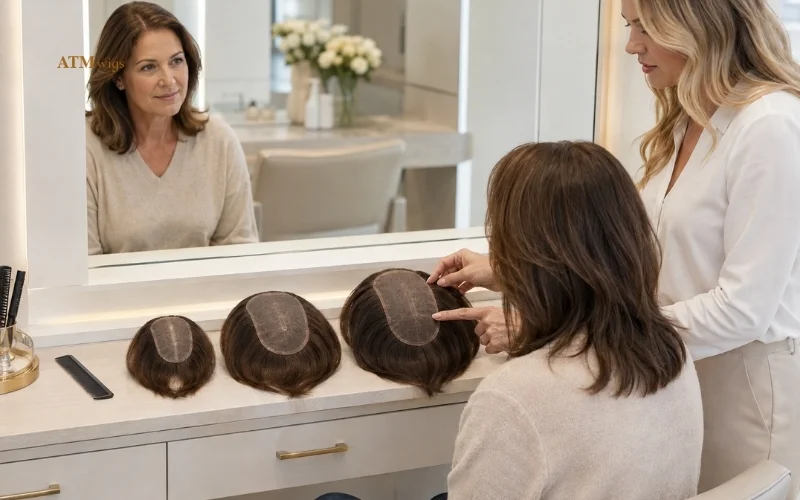
Hair toppers vs wigs: what is the difference?
Hair toppers and wigs both provide additional hair coverage, but they serve different needs.
| Factor | Hair topper | Wig |
|---|---|---|
| Coverage | Partial | Full scalp |
| Natural hair visible | Usually yes | Usually covered |
| Main purpose | Targeted coverage and volume | Complete coverage |
| Base size | Smaller | Full cap |
| Blending | Integrates with natural hair | Creates the full hairstyle |
| Suitable for | Localized thinning | Broader or complete coverage |
If there is natural hair surrounding the thinning area and you only need coverage in a specific spot, a topper is usually selected.
A wig may be more suitable when the wearer wants complete coverage or when there is not enough natural hair to blend with a topper.
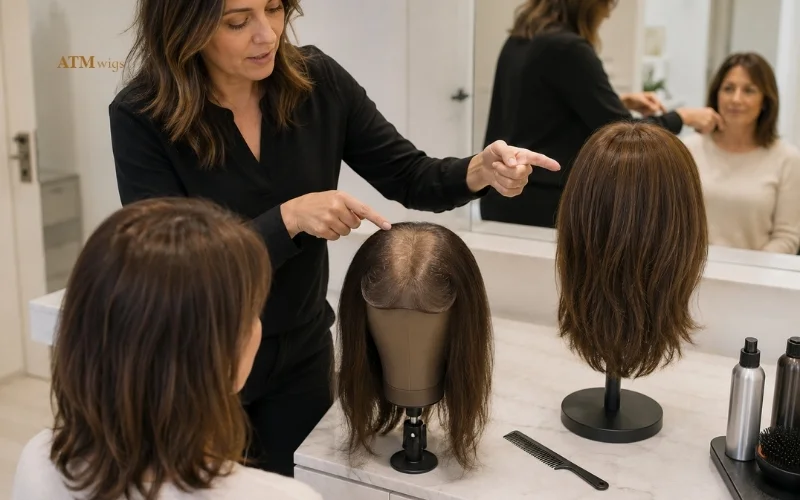
How to wear and blend a hair topper naturally
A natural result depends on correct positioning as much as the topper itself.
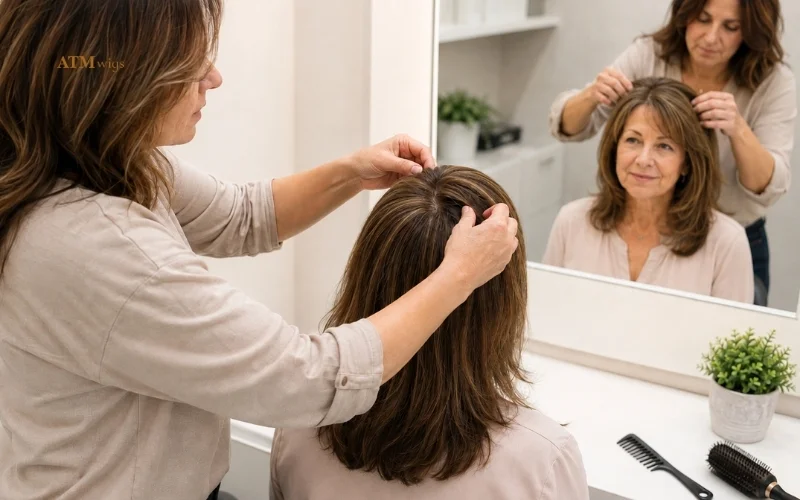
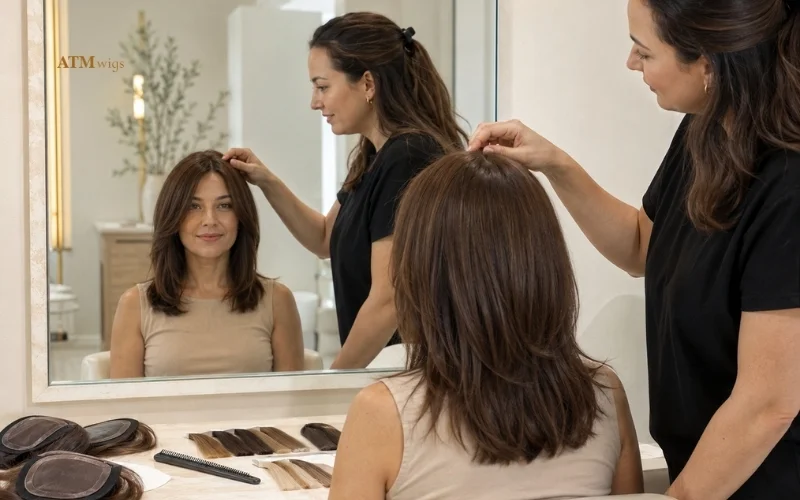
Place the base directly over the area to be covered, ensuring that the hair part and direction look natural before securing it in place.
For clip-in toppers, clip the clips into secure natural hair without causing undue pulling or tension.
Once you have secured the topper, blend the added hair with your own hair with your fingers, a wide-tooth comb or a suitable brush.
Professional trimming or shaping can be done to improve the transition between the topper and the existing haircut.
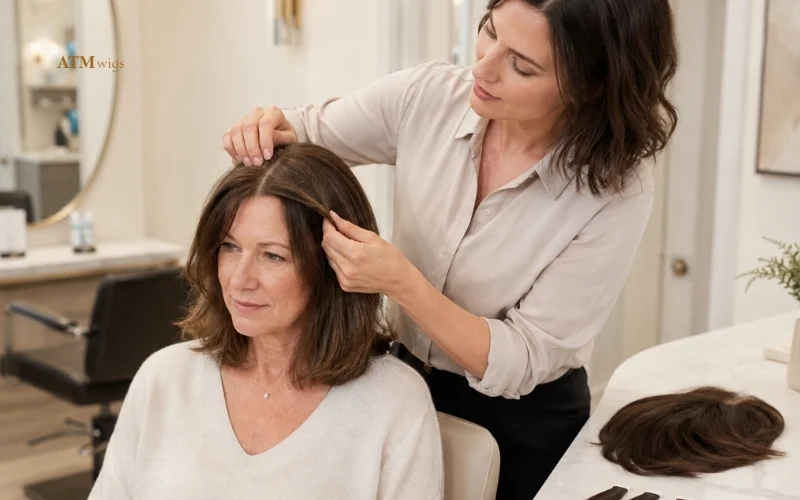
What makes a hair topper look natural?
A realistic hair topper is determined by several elements working together.
The most important factors are the right base size, correct density, matching texture, correct color matching and natural looking parting.
Construction of the base also is important. Lace fronts, monofilament areas, and silk tops each have a different visual effect depending on the area of coverage needed.
The quality of the hair matters too, but even premium hair can look unnatural if the density or color doesn’t match the wearer.
To get the most natural look, the topper must look like an extension of the natural hair, not as a separate layer placed on top of the hair.
How to care for a human hair topper
Human hair toppers need gentle treatment to keep both the hair and base in good condition.
Instead of washing it too often, wash the topper when you start seeing oil, styling products or visible buildup.
Use appropriate hair care products and avoid aggressive rubbing, twisting and brushing when the hair is wet.
When styling, use moderate heat and appropriate heat protection. Excessive temperature can dry the hair and may also damage delicate base materials.
Store the topper clean and completely dry. A suitable stand can help preserve its shape while reducing tangling and unnecessary friction.
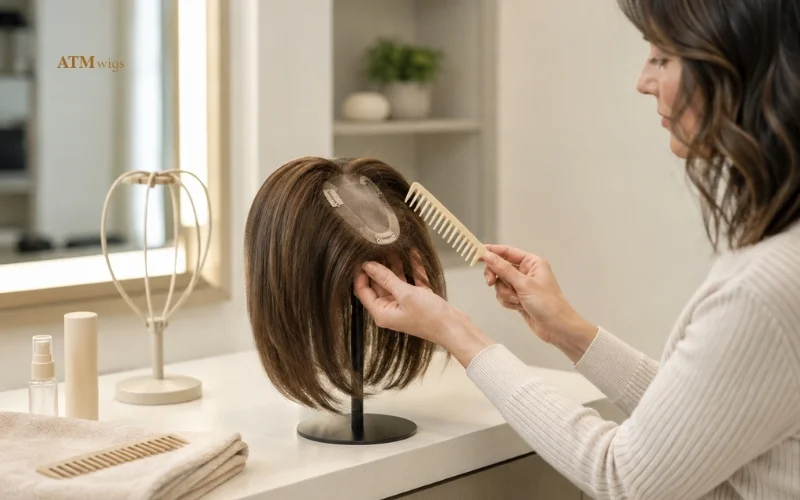
Choosing a natural-looking topper
The best topper is not only the longest, fullest or the most expensive choice.
It should be dense enough to cover but also match the wearer’s natural density, color, texture, haircut and everyday styling preferences.
The construction of the base should also be chosen according to where the thinning is and how the scalp or hairline should look.
When you take these factors into account, it will be easier to choose a topper that looks like it is a part of your natural hair rather than an obvious addition.
Explore ATM Wigs hair toppers
ATM Wigs offers human hair toppers in a variety of lengths, colors, base sizes, textures and constructions to suit a variety of coverage needs.
Comparing these specs before choosing a topper might help you find one that suits the thinning area and desired finished hairstyle.
FAQs about hair toppers
What is a hair topper?
A hair topper is a partial hairpiece that adds coverage or volume to the crown, part, or top of the head.
Unlike a wig, it normally blends with the wearer’s own hair.
Are hair toppers better than wigs for thinning hair?
Neither choice is necessarily better.
Hair toppers are a good option for targeted thinning when enough natural hair exists to blend, whereas wigs can provide more complete coverage when the thinning is more widespread.
Can you wear a hair topper every day?
Many hair toppers can be worn regularly when they fit correctly and are properly maintained.
The attachment should remain comfortable and should not create unnecessary tension on fragile natural hair.
Do hair toppers damage natural hair?
A properly fitted topper should not create excessive pulling.
However, repeatedly attaching clips to weak hair or placing them in exactly the same position can create stress over time, so attachment areas should be monitored carefully.
How do I choose the right size hair topper?
First, take a measurement of the area that needs coverage.
Pick a base that can fill the space, yet is small enough to sit securely and blend naturally into the surrounding hair.
Can hair toppers cover a thinning crown?
Yes. Hair toppers are often used to disguise thinning at the crown.
The base must be large enough to cover all the area that is visible thru the hair, with a density similar to the natural hair around it.
Can human hair toppers be styled?
Yes. Human hair toppers can usually be cut, curled, straightened, and styled similar to natural hair.
A moderate temperature and good hair care can help keep their condition.
How long do human hair toppers last?
Toppers do not all have the same lifespan.
Longevity is based on hair quality, base construction, how often you wear it, styling, washing, storage and how gentle you are with the topper.
Well-chosen toppers can provide targeted coverage, natural volume, and flexible styling without requiring a full wig. Explore the ATM Wigs catalog to compare human hair toppers for different coverage, color, length, and base needs.

